Périgord Tour – Rocamadour – Gouffre de Padirac – Oradour-sur-Glane
This 7-day, 6-night tour invites you to discover an exceptional region, with its medieval villages, castles, troglodytic sites, chasms, remarkable gardens and…
Fill up on discoveries
We organize your transport by coach, train or plane
Musées, Châteaux, grottes, parcs, jardins, villages, monuments historiques... Découvrez les plus beaux sites à visiter en France
Go alone or in a group to discover these places
You won't miss a single detail - they know their subject inside out.
Located in the Meuse département, in the Grand Est region of France, the Butte de Vauquois is one of the most impressive and emblematic sites of the First World War. Listed as a Historic Monument, today it offers a landscape unique in France, deeply marked by the fighting and upheavals associated with the conflict.
This guided tour offers groups a striking immersion in history, through a place where the traces of war are still visible and particularly striking. The Butte de Vauquois is a historical site, a place of remembrance and an educational space, providing a new understanding of the realities of the 1914-1918 war.
Before the outbreak of war, Vauquois was a village perched on a hilltop overlooking the surrounding plain. Its elevated position made it an essential strategic point for observing and controlling enemy movements.
In the early stages of the war, the hill became a major battleground for both the French and German armies. Fighting was particularly intense and prolonged, gradually transforming the village into a veritable battlefield.
Successive clashes led to the complete destruction of the village. Dwellings, streets and infrastructure disappeared, leaving a landscape deeply scarred by explosions and fighting.
Today, the Butte de Vauquois is best known for having been the scene of mine warfare, a particularly spectacular and destructive form of combat.
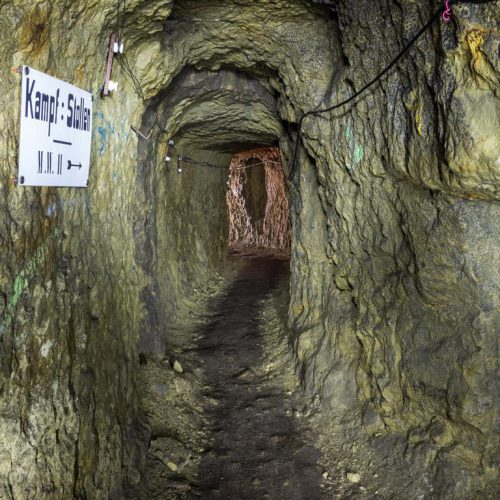
Both armies dug underground galleries beneath enemy lines to place explosive charges. These explosions created gigantic craters and permanently altered the relief of the site.
Over the months, this strategy transformed the hillock:
These craters are still visible today, and provide exceptional testimony to this type of combat. The Butte de Vauquois is one of the few sites where you can actually see the effects of mine warfare.
A visit to the site reveals a very special landscape, shaped by successive explosions. Unlike other places of remembrance, where the traces have been attenuated, here the relief itself bears the scars of the conflict.
The visitor evolves in an environment marked by :
This configuration makes for a particularly immersive visit, providing a better understanding of the scale of the destruction.
Accompanied by a guide, groups gradually discover the different facets of the site. The tour covers :
The guide provides precise, appropriate explanations, enabling everyone to understand the events that took place on this site.
Some of the routes also allow you to approach the entrances to the underground galleries, offering a concrete vision of how combat was organized underground.
Beyond its historical interest, the Butte de Vauquois is today an essential place of remembrance. It pays tribute to the soldiers who fought there, and passes on the story to future generations.
The visit is part of a specially adapted educational approach:
The site addresses important themes such as memory, transmission and understanding of conflict.
The Butte de Vauquois is particularly well suited to group visits. The itinerary is laid out in stages, allowing visitors to discover the site without any particular difficulty.
The tour offers :
The pace can be adapted to suit the group, ensuring a comfortable and rewarding discovery experience.
The Butte de Vauquois is a major site of the First World War, marked by mine warfare between 1914 and 1918. This strategic site was completely transformed by underground explosions, leaving a unique landscape of upheaval. The tour provides an insight into combat conditions, military issues and the importance of this site in the history of the conflict.
During the visit, visitors discover a terrain marked by explosion craters, as well as underground galleries dug by soldiers. The tour allows visitors to observe the remnants of the frontline, evoke the life of the combatants and understand the techniques used during mine warfare. This immersion offers a powerful and educational experience right on the battlefield.
A visit to the Butte de Vauquois is particularly suitable for groups, as it enables a collective approach to history and the duty of remembrance. On-site explanations make it easier to understand the events and living conditions of the soldiers. This outing is an enriching experience, both historical and human, accessible to a wide range of audiences.
This 7-day, 6-night tour invites you to discover an exceptional region, with its medieval villages, castles, troglodytic sites, chasms, remarkable gardens and…
This tour takes you on a surprising journey to the heart of the Île-de-France region, where aviation history meets beekeeping know-how. Between…
Visit General de Gaulle's final resting place at Colombey-les-Deux-Églises This tour offers groups the chance to immerse themselves in France's contemporary history,…
Would you like to plan a similar experience? Request your personalized itinerary.