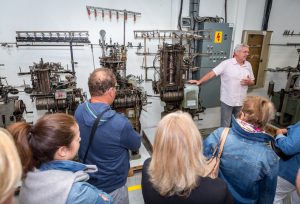
Industrial tour of the Kindy sock factory
The Bloquert-Davesne family business on rue des Bonnetiers has been in existence since 1863.
Fill up on discoveries
We organize your transport by coach, train or plane
Partez à la visite d'une entreprise, Découvrez ses secrets de fabrication
Go alone or in a group to discover these places
You won't miss a single detail - they know their subject inside out.
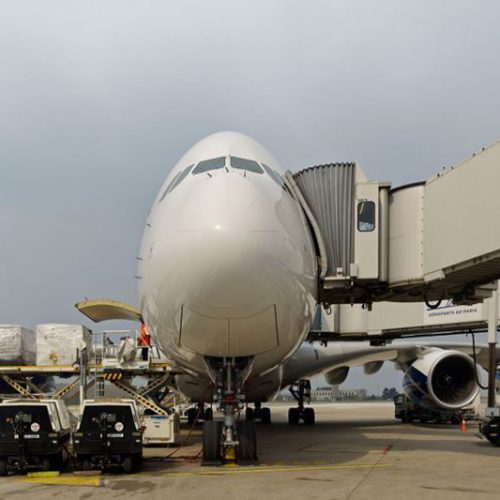
From the air, an airport appears as lines and lights. Up close, it is a living system—part transportation hub, part economic platform—where thousands of moving pieces must align with precision. Paris‑Orly, one of the capital’s two main airports, has long been described as a “ville dans la ville,” a city within the city.
This guided visit invites you to understand how it functions: the coordination of passenger flows and aircraft movements, how baggage and security processes interlock, and the range of professions that keep the platform running day after day. Clear, accessible explanations turn a complex environment into an intelligible whole.
Airports are often experienced in fragments: a check‑in counter here, a gate there, a glimpse of an aircraft beyond the glass. This guided visit steps back from the traveler’s tunnel vision to consider the entire organism. You’ll learn how flows interlock—how passengers, bags, crews, ground vehicles, and aircraft are each governed by rules and rhythms that must align. You’ll consider the airport as an economic and logistical platform too, where airlines, service providers, shops and logistics activities coexist in a shared, highly regulated ecosystem.
Orly provides a particularly clear case study. Following a major modernization, its facilities have been organized and signposted as Orly 1–2–3–4 since 2019, a pragmatic framework that helps make sense of the platform’s geography. At the same time, a government‑mandated night curfew shapes what can and cannot happen overnight. Observing how such parameters influence planning offers insight into why a day at a major airport looks the way it does.
What does it take to move a city’s worth of travelers and aircraft safely and efficiently? Your guide unpacks the nuts and bolts with clear, structured explanations:
Passenger flows and checkpoints. How movement is directed through successive zones, why certain checks must occur in a particular order, and how these layers interact with airline and border‑control requirements.
Aircraft movements on the ground. The careful sequencing behind pushback, taxiing, and stand allocation, and how runway use can change with operations, works, or weather.
Baggage handling as a system. How checked baggage is routed, reconciled and delivered within a time‑sensitive network.
Security and controls. How multiple actors and procedures combine to protect the platform while keeping flows moving.
This is not a checklist of places so much as a way of seeing an airport—understanding how interdependent processes form a single, resilient mechanism.
Airports run on expertise as much as they do on concrete and steel. The visit highlights the diversity of airport professions and how each contributes to the whole: ground agents and logistics personnel who choreograph aircraft turnarounds; security staff who safeguard the platform; maintenance technicians who keep equipment reliable; and air traffic controllers whose work orchestrates movement in the surrounding airspace. Seeing these roles in relation to one another reveals an airport’s true complexity—and why coordination is everything.
Several durable characteristics shape Orly’s identity and operations:
These elements are not a visitor schedule; they are the operational backdrop that helps explain how and why airport decisions are made.
This is a guided visit at Paris‑Orly Airport centered on understanding how a major international platform functions behind the scenes. Expect a pedagogical, accessible approach that clarifies complex notions for non‑specialists. The emphasis is on how flows are coordinated—passengers, aircraft movements, baggage handling, security and controls—and on the range of professions required to make that coordination work. You’ll also consider the airport as a broader economic and logistical ecosystem, where airlines, services, shops and logistics activities interrelate.
Routes and specific spaces visited are intentionally not detailed here, and no particular area or vantage point is implied. The value of the experience lies in the explanations that help you read the airport differently: not as a sequence of queues and corridors, but as a carefully engineered system with its own language and logic.
Considering a custom Paris plan built around learning and discovery? Speak with Suite Voyage Discovery about tailoring your trip, including this guided look at how Paris‑Orly works. Request a custom quote.
Understanding an airport changes how you experience it. Once you see how processes interconnect, everyday travel becomes more legible—and often less stressful. You grasp why certain steps happen in a given sequence, how ground operations and airspace coordination influence timing, and how constraints such as Orly’s night curfew shape the day. This perspective doesn’t just satisfy curiosity; it cultivates a more informed, empathetic way of moving through one of the world’s most complex public interfaces.
Airports condense the story of a metropolis: technology, regulation, urban planning, environmental priorities, and public mobility all converge here. Orly’s 1–2–3–4 terminal organization speaks to clarity and integration; the Line 14 extension situates the airport within a broader shift toward high‑capacity public transit; curfew rules foreground how communities and infrastructure coexist. Looking at Paris through Orly is a reminder that a global city is also a web of systems—disciplined, adaptive, and designed to serve millions.
If understanding how a place works is part of why you travel, Orly offers a compelling lens on the capital. From here, it’s natural to explore other layers of the Paris region’s contemporary story—mobility, design, science, culture—each showing how a modern metropolis thinks and builds. Suite Voyage Discovery can help you weave this guided visit into a broader narrative of Paris and Île‑de‑France that fits your interests and pace.
Ready to see Paris‑Orly through an insider’s lens—without the jargon? Suite Voyage Discovery will shape a tailored plan around this guided visit and the themes you care about most. Start your custom quote.
The visit explores how a large international airport functions as a system. You’ll gain a clear understanding of how flows are coordinated—passengers, aircraft movements, baggage handling, and security and controls—and how a wide range of airport professions interconnect to keep the platform running. Explanations are structured and accessible for non‑specialists.
Routes and specific spaces are not specified in the program, and no particular area or vantage point is implied. You should not assume airside access or entry to restricted facilities such as a control tower. The strength of the visit lies in its explanations and orientation to how the airport works rather than in any specific restricted‑area access.
Paris‑Orly is one of the capital’s two main airports, operated within the Paris Aéroport network by Groupe ADP. Its facilities have been organized and signposted as Orly 1–2–3–4 since 2019, providing a clear framework for understanding the platform’s layout. Orly also operates under a government‑regulated night curfew, which is a useful lens for understanding operational rhythms. In June 2024, Metro Line 14 opened a direct station within the airport precinct, reflecting the site’s place in the Grand Paris Express network. From time to time, infrastructure works can alter runway usage and flight paths—another window onto how airports adapt operationally.
The Bloquert-Davesne family business on rue des Bonnetiers has been in existence since 1863.
Where industry forged identity and art reframes the past, French Flanders offers a compact, culture-rich journey. Over two days, guided visits lead…
Even in a country of great cathedrals, Beauvais stands apart. Step into Saint‑Pierre Cathedral and the space rises almost impossibly: the world’s…
Would you like to plan a similar experience? Request your personalized itinerary.