Saint-Germain-des-Prés in Paris: Literature, Jazz, Art, and Left Bank History
Saint-Germain-des-Prés: Where the Idea of the Left Bank Was Born Few Paris neighborhoods carry as much cultural mythology as Saint-Germain-des-Prés. Its name…
Fill up on discoveries
The discovery promenade will be guided for everyone.
Go alone or in a group to discover these places
You won't miss a single detail - they know their subject inside out.
A universal symbol of Paris, the Eiffel Tower is far more than its outline. Around it unfolds one of the capital’s most spectacular monumental landscapes, shaped by the great World’s Fairs, the architectural ambitions of the 19th century, and the urban transformations of the 20th.
This guided tour of the Eiffel Tower and the Trocadéro invites you to experience this emblematic district in a different way. From Trocadéro’s sweeping perspectives to the Champ‑de‑Mars, your guide leads a walk where architecture, history, technical feats, and major international events meet.
From the Trocadéro to the Champ-de-Mars, take in the key places that shape this monumental landscape.
The grand balcony facing the Eiffel Tower
Vast vistas toward the Seine
Crossing through the heart of the monumental landscape
The Paris icon and its history
The grand vista of the World’s Fairs
Why did Gustave Eiffel build a 300‑meter tower in the heart of Paris? Why was it originally meant to be temporary? How did the World’s Fairs reshape the banks of the Seine? And how did the Eiffel Tower, fiercely criticized during its construction, become one of the most famous monuments in the world?
An ideal walk if you want to explore the history of the Eiffel Tower without necessarily planning to go up, while enjoying some of the finest panoramas in Paris.
Click a photo to enlarge
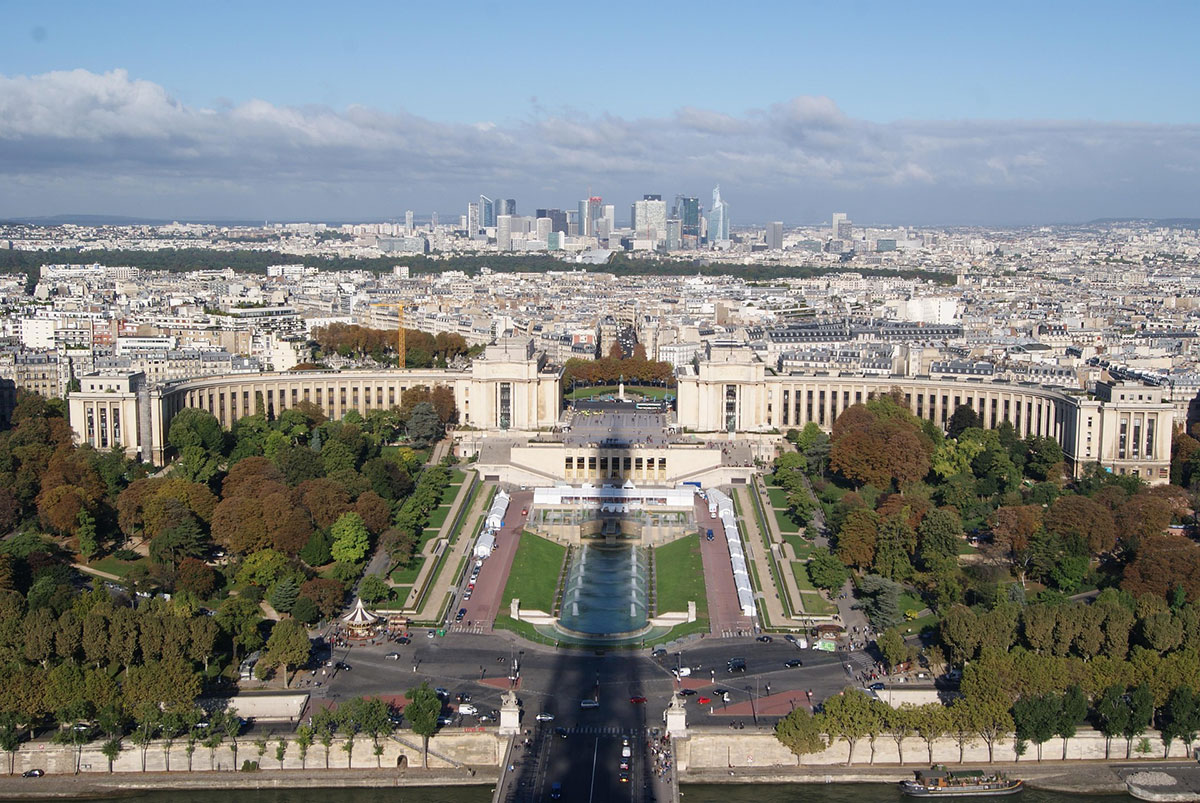
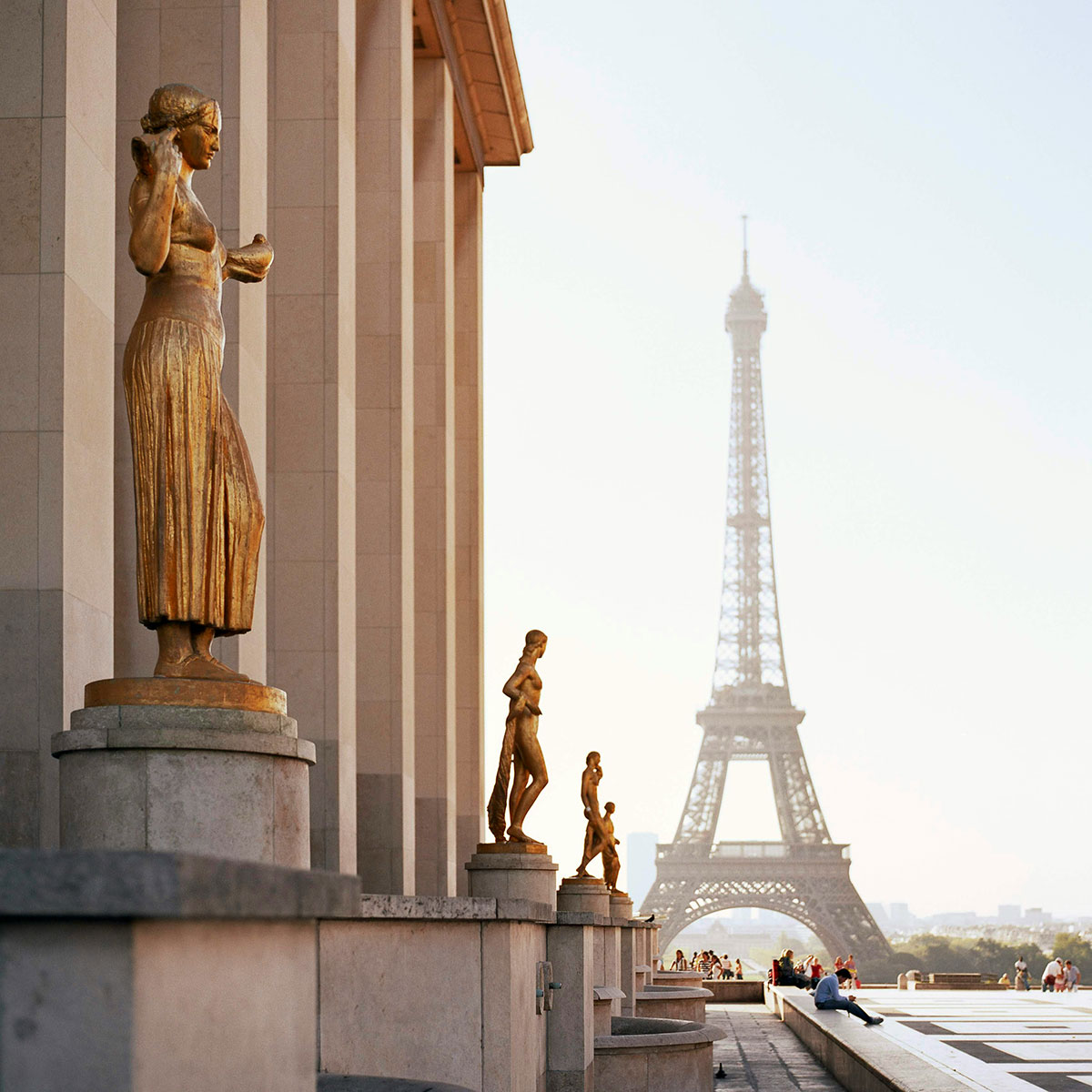
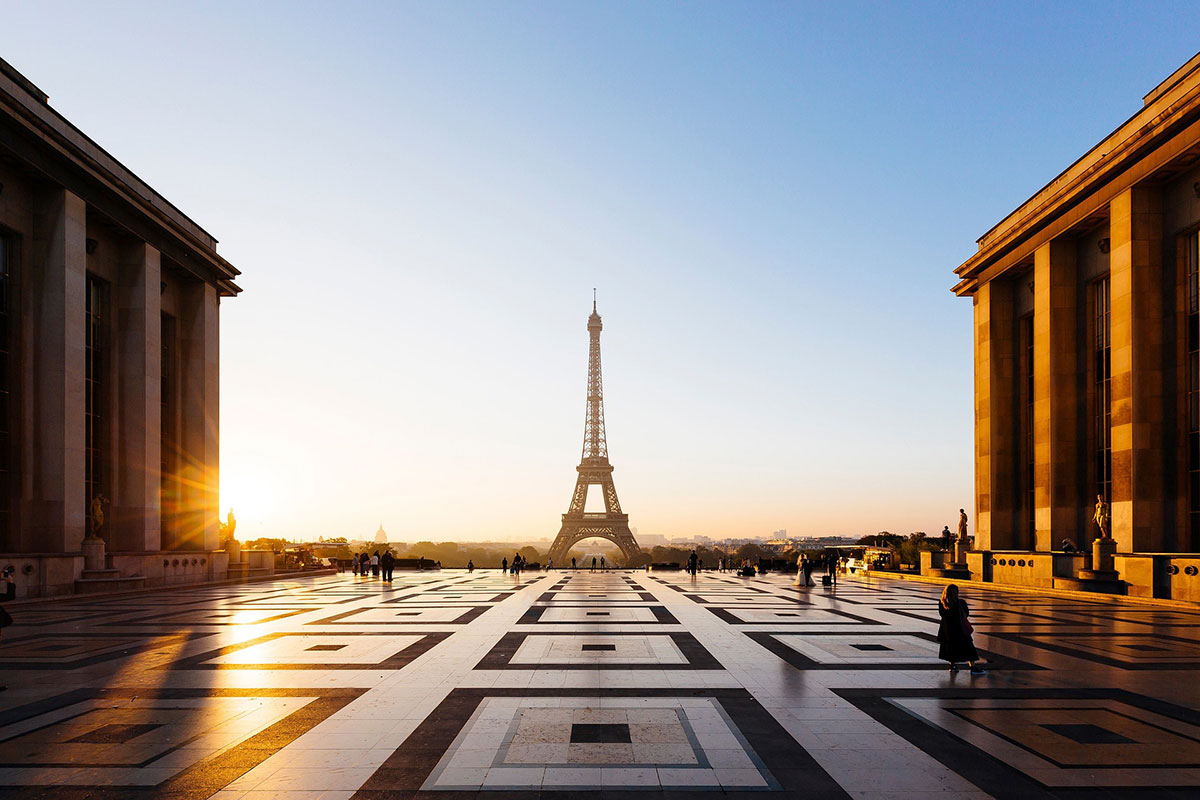
The tour can begin on the heights of the Trocadéro, one of Paris’s most famous viewpoints: the Eiffel Tower rises over the Seine and the Champ‑de‑Mars, with the broad lines of the Parisian landscape unfolding in the distance.
Before heading down toward the Iron Lady, take a moment to look around. The setting we know today is the result of several generations of planning tied to major international events hosted in Paris.
The current Palais de Chaillot was built for the 1937 International Exposition. Its two monumental wings frame a vast terrace opening toward the Eiffel Tower. It replaced the former Palais du Trocadéro, erected for the 1878 World’s Fair, whose spectacular architecture had left a deep mark on the right bank’s landscape.
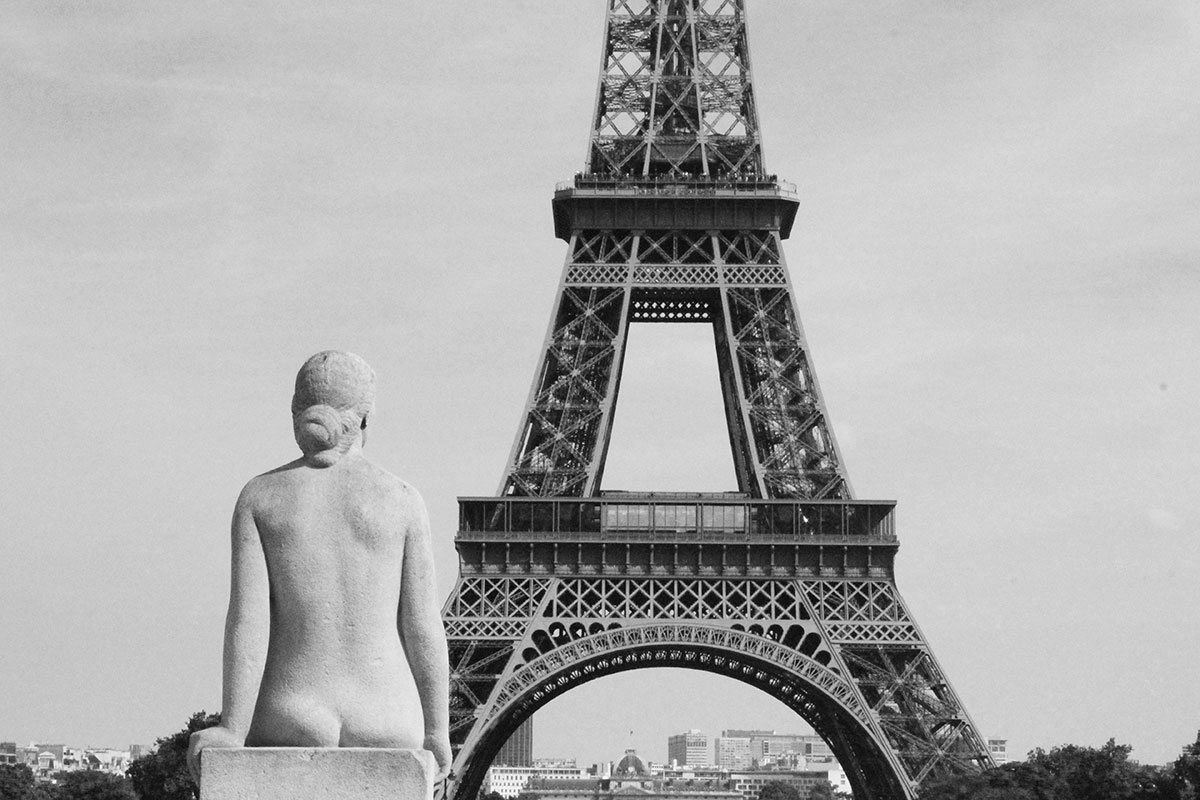
This face‑off between the Palais de Chaillot and the Eiffel Tower already reveals several decades of Parisian history: within a few hundred yards, the legacies of the 1878, 1889, and 1937 expositions overlap.
In the 19th century, World’s Fairs became gigantic showcases of progress. Nations presented their industrial, scientific, and artistic innovations while host cities competed to build ever more daring structures.
Paris hosted several of these events. For a few months at a time, immense palaces, exotic pavilions, industrial galleries, and experimental constructions transformed parts of the capital.
The 1889 World’s Fair, organized for the centenary of the French Revolution, was meant to make a lasting impression.
To mark the site’s entrance, an extraordinary project took shape: a 300‑meter metal tower.
At a time when Parisian buildings were only a few stories high, the project seemed almost out of scale.
The name Gustave Eiffel is now inseparable from the monument. Yet the Tower’s story is also that of a team of engineers and architects working within his company.
Engineers Maurice Koechlin and Émile Nouguier conceived the idea for a gigantic metal tower. Architect Stephen Sauvestre then helped give the project its architectural appearance, before Gustave Eiffel championed it with the full authority and expertise of his firm.
Work began in 1887.
Thousands of metal components were fabricated with remarkable precision before being assembled on the Champ‑de‑Mars. Little by little, four immense legs rose and joined to form a structure whose curves responded as much to technical constraints as to the need to withstand the wind.
In just over two years, the challenge was met.
The Eiffel Tower was completed in 1889 and became the tallest construction in the world, a record it would hold for more than four decades.
Today, it’s almost impossible to imagine Paris without the Eiffel Tower.
Originally, however, its presence was not intended to be permanent. The concession granted to Gustave Eiffel provided for a twenty‑year operation. At the end of that period, the Tower could, in theory, have been dismantled.
This provisional destiny partly explains one of the most fascinating aspects of its story: the Eiffel Tower had to prove its usefulness to survive.
Gustave Eiffel encouraged scientific experiments conducted from the monument. Astronomy, meteorology, aerodynamics, and especially wireless telegraphy gradually gave it a purpose that went far beyond serving as a spectacular gateway to a World’s Fair.
The development of radio transmissions played a decisive role in its preservation.
Before becoming a national symbol, the Eiffel Tower sparked fierce controversy.
In 1887, artists, writers, and architects published a protest against its construction. They denounced the arrival, in the heart of Paris, of a gigantic metal structure they deemed incompatible with the capital’s beauty.
That opposition seems surprising today, given how inseparable the Tower’s silhouette now feels from the Paris landscape.
Yet it underscores just how revolutionary the monument was.
By the late 19th century, metal was already ubiquitous in train stations, bridges, and industrial buildings. But using it to create a 300‑meter monumental construction, visible from much of Paris, upended traditional architectural codes.
The Eiffel Tower doesn’t conceal its frame: its structure is its architecture.
The walk then descends through the Trocadéro gardens.
The perspective gradually shifts. From the terrace, the Eiffel Tower can seem like part of a perfectly composed backdrop. As you approach the Seine, its dimensions become far more palpable.
The gardens and their basins are themselves part of the grand monumental layout conceived around the Palais de Chaillot.
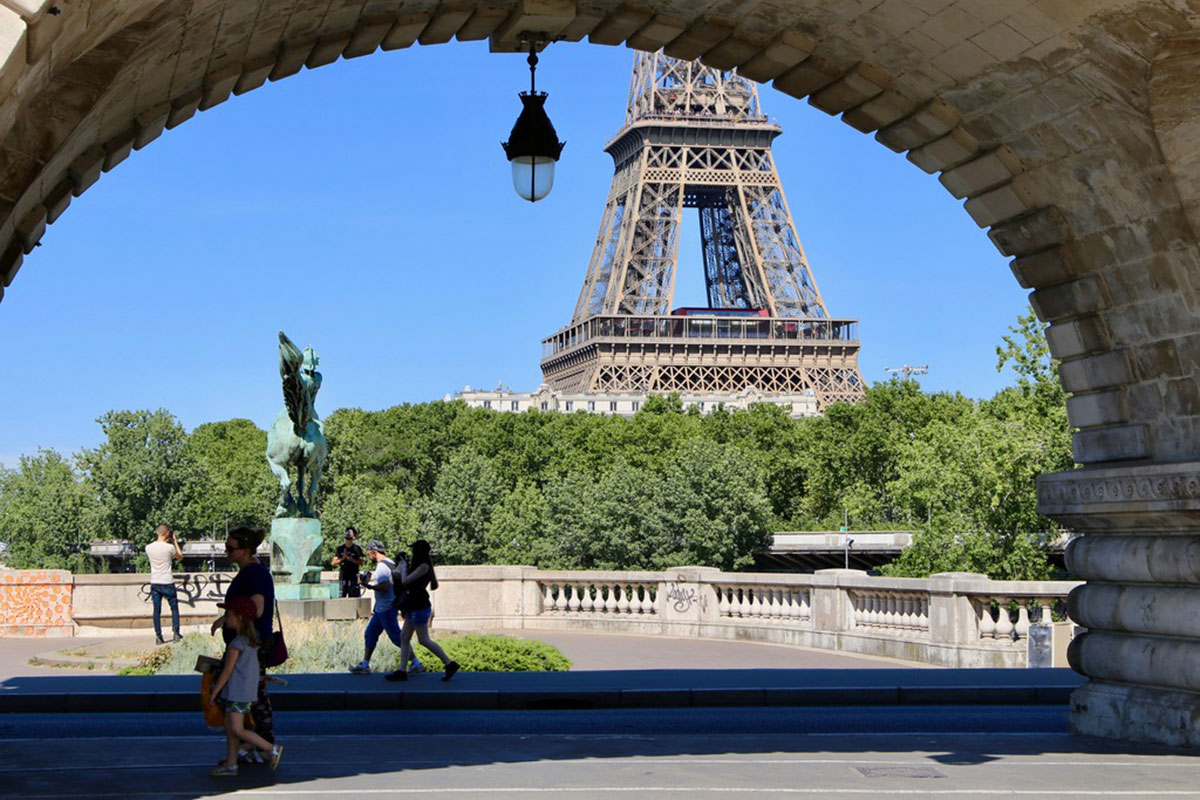
The route then leads to the Pont d’Iéna, which links the Trocadéro directly to the Champ‑de‑Mars.
Built under Napoleon I and named in memory of the 1806 victory at Jena, the bridge predates the Eiffel Tower by many years. It’s a reminder that the neighborhood’s history did not begin with the 1889 World’s Fair.
Crossing the Seine, the monument shifts scale once again.
From a distance, the Eiffel Tower appears light and almost graphic. At its base, it becomes an extraordinary feat of industrial construction.
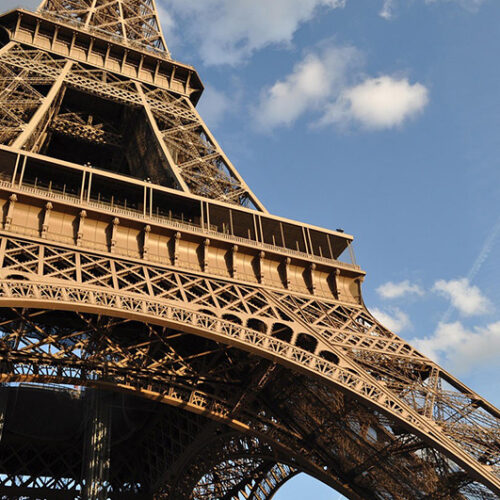
Its legs, metal joints, and interlaced structure make it easier to grasp the audacity of the project imagined at the end of the 19th century.
This is also a chance to evoke the Tower’s life since 1889: the millions of visitors who have come to see it, its illuminations, its scientific uses, radio transmissions, the events that have showcased it, and the successive transformations that have helped it remain one of Paris’s most visited monuments.
More than a century after its construction, it remains both an engineering triumph and an extraordinary machine for producing images of Paris.
The tour continues across the Champ‑de‑Mars.
Long before the Eiffel Tower arrived, this vast stretch in front of the École Militaire served, among other uses, as a training ground for troops. Its history is also linked to several major episodes of the French Revolution, before becoming one of the principal sites for Paris’s World’s Fairs.
On several occasions, immense temporary palaces occupied the grounds.
Most have disappeared, a reminder of the ephemeral nature of these events that could transform Paris for a few months before giving way to a new city.
The Eiffel Tower is the most spectacular exception: built for a temporary event, it ultimately spanned the generations.
This walk isn’t simply about multiplying viewpoints on the monument.
It places the Eiffel Tower back into the urban landscape that gave birth to it and helps explain why it represents far more than a technical feat.
It tells the story of an era fascinated by progress, a capital intent on impressing the world, engineers capable of imagining unprecedented constructions, and a society torn between enthusiasm for modernity and fear of losing traditional Paris.
From the Trocadéro to the Champ‑de‑Mars, what emerges around the Eiffel Tower is the story of how modern Paris was born.
This guided tour can stand on its own or serve as the starting point for a more complete exploration of this part of Paris.
Depending on your available time, interests, and booking conditions, several extensions can be considered.
Suite Voyage Discovery adapts the route to you—to your schedule and to the other visits planned during your time in Paris.
This walk can be arranged as a standalone half‑day or integrated into a more extensive Paris program. A cruise, a lunch, a museum visit, or—when possible—an ascent of the Eiffel Tower can be added on request.
Contact us to plan an Eiffel Tower and Trocadéro experience tailored to you.
No, not necessarily. This guided tour is designed as a true discovery of the Trocadéro, the surroundings of the Eiffel Tower, and the Champ‑de‑Mars. Your guide traces the monument’s history, its construction for the 1889 World’s Fair, and the neighborhood’s transformations while enjoying different viewpoints of the Tower. The ascent can be arranged separately when availability and booking conditions allow.
The tour lasts about 2 hours, depending on your pace and the route chosen. It takes in the Trocadéro, the gardens, the Pont d’Iéna, the surroundings of the Eiffel Tower, and the Champ‑de‑Mars without focusing the visit on the ascent alone. The program can also be adapted as part of a more complete half‑day.
Yes. A Seine cruise is one of the most natural extensions of this visit, with several piers located near the Eiffel Tower. After discovering the neighborhood on foot, you can view Paris from the river and enjoy another perspective on its monuments, bridges, and quays. This option can be included in a tailor‑made program according to schedules and availability.
Saint-Germain-des-Prés: Where the Idea of the Left Bank Was Born Few Paris neighborhoods carry as much cultural mythology as Saint-Germain-des-Prés. Its name…
Paris keeps its past in plain sight, and nowhere does the city read more clearly than in the Marais. Here, an early‑17th‑century…
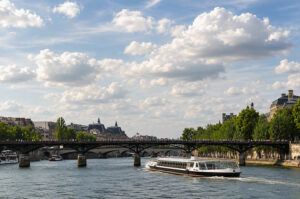
There is a reason the very heart of Paris is defined by its river. The historic banks of the Seine—bridges, quays and…
Would you like to plan a similar experience? Request your personalized itinerary.