
Visit the Opéra Garnier and covered passageways in Paris
Opéra Garnier and covered passageways in Paris: an elegant immersion in the heart of Parisian heritage In the heart of Paris, few…
Fill up on discoveries
The discovery promenade will be guided for everyone.
Go alone or in a group to discover these places
You won't miss a single detail - they know their subject inside out.
Beyond its great monuments, boulevards, and museums, Paris has another face: a city of quiet lanes, unexpected houses, independent shops, and neighborhoods with stories of their own. You don’t have to leave the capital to find places that feel remarkably far from its most familiar sights.
This guided walk through the 14th arrondissement introduces a more intimate, less familiar Paris, just beyond the bustle of Montparnasse. Its pleasures are found in the details: a semicircular square, the scale of a residential street, the character of a market district, and the history concealed beneath an ordinary city square.
A hidden village in the heart of Paris
The feel of a neighborhood that has kept its soul
Gourmet shops, terraces, and memories of Agnès Varda
From the Lion of Belfort to the mysteries of underground Paris
The walk ends at the Catacombs entrance. Optional interior visit by reservation.
From the former Village d’Orléans and Petit-Montrouge to lively Rue Daguerre and Place Denfert-Rochereau, the route brings together village-like streets, everyday Parisian life, and intriguing urban history. The walk ends outside the entrance to the Paris Catacombs; an underground visit can be arranged separately as an option.
This is a walk for travelers who enjoy understanding a city through its neighborhoods rather than moving from one major attraction to the next. The 14th arrondissement makes an especially engaging setting because its streets offer such distinct impressions within a relatively compact area: peaceful residential corners, an active shopping street, a square recalling the city’s former boundaries, and an entrance to a remarkable underground site.
The thread connecting the stops is the changing relationship between Paris and its neighborhoods. Petit-Montrouge recalls an area that was not always part of the capital. Rue Daguerre reveals the continuing importance of local food shops and familiar routines. Denfert-Rochereau links the visible city to the quarries and ossuary below. A guide helps bring these connections into focus without turning the experience into a formal history lecture.
The walk begins where the size and rhythm of Paris seem to change. Near Rue Hallé, a small semicircular square is bordered by houses whose varied façades, gates, and gardens create a setting quite unlike the grand boulevards that dominate many visitors’ image of the city. Its appeal is immediate, but the story behind it is equally worth discovering.
The houses recall the Nouveau Village d’Orléans, a residential development laid out in the 19th century. The idea of a village within Paris becomes tangible here: individual houses rather than imposing apartment blocks, domestic gardens rather than monumental perspectives, and details that reward a slower look. The surroundings invite you to pay attention to what is visible from the public street, without assuming that the private properties or gardens are open to visitors.
What makes this stop memorable is not a single spectacular monument. It is the contrast between a distinctive residential setting and the modern capital around it. The guide can introduce the area’s history while allowing time to notice the different façades, the arrangement of the houses, and the quiet character that survives within today’s Paris.
From Rue Hallé, the walk continues into Petit-Montrouge. Even the neighborhood’s name offers a clue to its past: this area has not always belonged to Paris. As the route unfolds, that older identity provides a useful way to understand why certain streets and squares feel different from the monumental center of the city.
Around Rue Mouton-Duvernet, local shops, cafés, and smaller public spaces give the walk another rhythm. Square de l’Aspirant-Dunand and the area near the 14th arrondissement town hall provide points of reference and an opportunity to pause. Depending on the day, you may also encounter the activity associated with the neighborhood market. The experience is about observing an inhabited district, not following a staged reconstruction of old Paris.
Here, the guide’s commentary can connect former boundaries with the present-day neighborhood. A street name, an unexpected building, or the way a square opens between surrounding streets becomes more meaningful when seen as part of a changing city. Petit-Montrouge rewards attention to ordinary details that are easy to overlook when rushing between landmarks.
The atmosphere becomes livelier along Rue Daguerre. Bakery windows, produce displays, neighborhood food shops, cafés, and terraces give the street a distinct personality. Rather than presenting Parisian food culture as a collection of famous dishes, this stop offers a chance to see how it is woven into the life of a shopping street.
The guide can discuss the role of independent food businesses and everyday shopping habits: choosing products, recognizing different specialties, and understanding why neighborhood shops remain such visible meeting points in Paris. Even without a tasting, there is plenty to notice in the storefronts and the changing activity along the street. A coffee, pastry, or other food stop may be considered separately, according to your preferences and what can be arranged.
Rue Daguerre also has a place in cinema history. Agnès Varda, a major figure in French filmmaking, lived here for many years and made Daguerréotypes, a documentary centered on neighborhood shopkeepers. Her connection to the street adds another dimension to the visit. What might first seem like a pleasant stretch of shops also becomes a place where the lives and work of ordinary Parisians were made the subject of a film.
That combination of food, local routines, and artistic memory gives Rue Daguerre its importance on this itinerary. It offers a vivid contrast with the quieter residential lanes encountered earlier, while remaining firmly rooted in the same arrondissement.
The walk continues to Place Denfert-Rochereau, where the story shifts from neighborhood streets to a broader history of Paris. The square takes its present name from Colonel Denfert-Rochereau, associated with the defense of Belfort during the Franco-Prussian War of 1870. Its earlier name, Place d’Enfer, sounds especially suggestive today given the underground galleries nearby, although the name is part of the square’s own history rather than a reference to the modern visitor attraction.
At the center stands the Lion of Belfort, a sculpture by Auguste Bartholdi, who also created the Statue of Liberty. Nearby, the surviving pavilions of the former Barrière d’Enfer recall a period when the limits of Paris were marked by barriers. These landmarks are very different in appearance and purpose, yet together they help explain why this square is more than a transport junction or the location of a famous entrance.
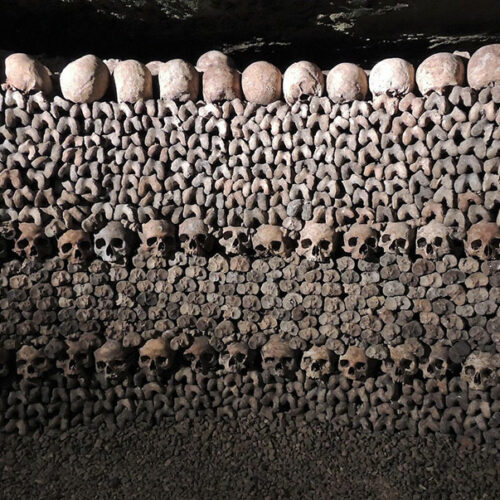
The most unexpected part of the story lies below ground. For centuries, stone extracted from quarries beneath Paris contributed to the construction of the city above. In the late 18th century, amid serious sanitary problems associated with urban cemeteries, some former quarry galleries were adapted to receive human remains. This process led to the creation of the municipal ossuary now known as the Paris Catacombs.
Denfert-Rochereau brings these layers of Paris together: a former gateway to the city, a public square with a historic monument, and the entrance to an underground world shaped by building activity and the management of the city’s cemeteries. Understanding that relationship makes the end of the outdoor walk a natural conclusion rather than an abrupt stop.
The guided outdoor route finishes near the entrance to the Paris Catacombs. By this point, the story of the quarries and the ossuary has already been introduced from above ground. You can enjoy the entire neighborhood walk without going underground. For travelers who want to continue, a separate Catacombs visit may be added, subject to reservations, availability, and the site’s admission conditions.
For those interested in extending the experience, the Catacombs reveal a very different aspect of Paris. Around 20 meters (approximately 65 feet) below street level, a one-way underground circuit passes through former quarry galleries and the municipal ossuary, where the remains of millions of Parisians were transferred. Its historical significance comes from the relationship between the old quarries, the overcrowded cemeteries of the 18th century, and the city above.
The official visitor circuit covers approximately 1.5 kilometers (0.9 miles); allow about an hour. Conditions are very different from those of the outdoor stroll: the temperature is typically around 14°C (57°F), passages can be narrow, and the ground may be uneven or slippery. There are 243 steps in total—131 down and 112 up—and no step-free access. The visit is therefore unsuitable for some travelers, particularly those with certain mobility limitations or health concerns.
Catacombs admission is not included automatically in the guided neighborhood walk. Ticketing and any accompanying arrangements must be confirmed separately, according to current availability and the site’s rules. This distinction matters when planning a personalized outing: the above-ground walk offers a complete experience in its own right, while the underground circuit is an additional choice.
You don’t need specialist knowledge of architecture, art, or history to enjoy this route. Its appeal comes from moving between different kinds of Parisian spaces and understanding the details that distinguish them. Quiet houses around Rue Hallé, everyday activity in Petit-Montrouge, the food culture of Rue Daguerre, and the layered history of Denfert-Rochereau all have something to offer visitors who want to see beyond the most familiar sights.
The walk can suit individual travelers, couples, families, friends, or private groups interested in a relaxed, guided introduction to the area. The route and its pace can be discussed when planning the visit. Any specific accessibility needs should be raised in advance; the possibility of adapting the outdoor walk does not mean that every surface or stop will suit every visitor, and the underground Catacombs have separate, more restrictive conditions.
If you’d like to include a coffee or pastry stop around Rue Daguerre, that can be explored as part of your customized plans. The same is true of further discoveries nearby: Rue des Thermopyles and Cité Anne-Marie-Bauer for a picturesque continuation, Parc Montsouris for a green escape, or Montparnasse for another walk tracing its artists and writers. These are optional ways to extend your day, not stops included in the main two-hour route.
Would you enjoy discovering an intimate Paris of village-style streets, independent shops, and surprising local stories? Suite Voyage Discovery creates personalized visits around your interests, preferred pace, and available time. Whether you choose the neighborhood walk on its own or discuss an additional food stop or Catacombs visit, the aim is to shape a coherent experience rather than simply combine attractions.
Request a customized itinerary and quote for your guided walk through the 14th arrondissement.
All programs and pricing are provided on request. Optional activities depend on their individual arrangements and availability.
The guided walk ends near the Catacombs entrance. An underground visit can be arranged separately as an optional addition, subject to advance booking, availability, and the site’s admission conditions. It is not included in the outdoor walk.
Not at all. The outdoor tour is a complete experience in its own right, covering Rue Hallé, Petit-Montrouge, Rue Daguerre, and Place Denfert-Rochereau. The Catacombs interior is entirely optional.
We can discuss the pace and suitability of the outdoor walk when tailoring your visit. The underground Catacombs circuit has 243 steps, narrow passages, and uneven ground, and does not offer step-free access. Please share any accessibility needs before booking.
Opéra Garnier and covered passageways in Paris: an elegant immersion in the heart of Parisian heritage In the heart of Paris, few…
Step through the gates of the Château de Fontainebleau and you enter eight centuries of French history under one roof—an exceptional continuity…

Just south of Paris, while the city sleeps, the world’s largest fresh food market is already wide awake. Rungis International Market operates…
Would you like to plan a similar experience? Request your personalized itinerary.