
Guided tour of Montmartre — from artists’ village to the Sacré‑Cœur
Montmartre is one of those neighborhoods you feel you know before you ever arrive. The Sacré-Cœur, the painters on Place du Tertre,…
Fill up on discoveries
We organize your transport by coach, train or plane
Marchez dans les pas des maquisards, traversez une zone de parachutage, découvrez le quotidien des combattants...
Go alone or in a group to discover these places
You won't miss a single detail - they know their subject inside out.
This tour offers groups a complete and entertaining immersion in the rural world, through a place that is both steeped in history and still fully alive.
Close to Paris, the Bergerie Nationale is a place where livestock breeding, royal history, pleasure architecture and the transmission of knowledge all come together. The Bergerie Nationale is more than just a farm open to the public: it’s also a place of remembrance, a site for agricultural experimentation and a particularly rich area for walking.
The Bergerie Nationale de Rambouillet has its origins in the late 18th century. In 1786, King Louis XVI decided to create an experimental agricultural establishment to improve French wool production. To this end, he had a flock of Merino sheep imported from Spain, renowned for the exceptional quality of their wool.
This project was part of a process of agricultural modernization, at a time when efforts were being made to improve breeding practices and develop the kingdom’s resources. The Bergerie thus became a place of innovation and observation, where agriculture was seen as a major economic challenge.
In the early 19th century, Napoleon I continued to develop the estate with the construction of new buildings to further structure the farm. The site grew in importance and became permanently organized around its agricultural vocation.
The Bergerie Nationale is inextricably linked with the Merinos de Rambouillet, a breed of sheep imported from Spain at the end of the 18th century. This species, famous for its particularly abundant fleece, has made the estate famous the world over.
It’s thanks to this unique breed of sheep that the Royal Farm has established itself as a benchmark. Today, the Rambouillet Merino is still a national genetic heritage, carefully preserved by the Bergerie.
Meeting these animals is one of the main attractions of the visit. For groups, it’s a unique opportunity to discover an emblematic breed, to understand its history and to appreciate the importance of conserving living organisms as part of France’s agricultural heritage.
This encounter with the herd gives a very concrete dimension to the visit, linking royal history, the wool economy and contemporary issues of breed preservation.
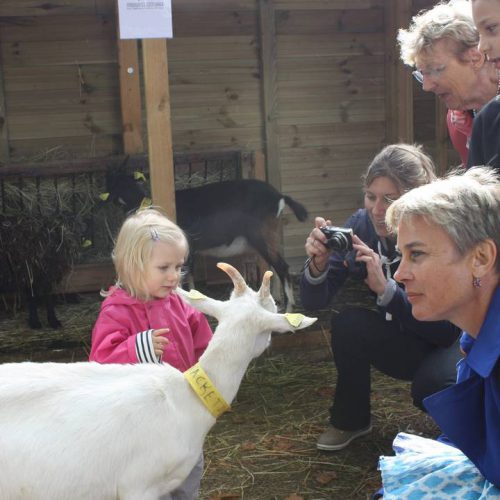
Today, the Bergerie Nationale is also an educational farm open to the public. The tour route allows visitors to discover different agricultural activities and get up close to several species of animals in a pleasant natural setting.
Visitors can observe :
This lively, accessible dimension is what makes the site so interesting. It provides a better understanding of how a farm works, the principles of animal husbandry and the links between man, animal and land.
For groups, this discovery is particularly popular, combining observation, education and the pleasure of a walk.
In addition to its agricultural vocation, the Bergerie nationale de Rambouillet is also home to a number of remarkable buildings, giving the visit an exceptional heritage dimension.
Among the most prestigious is the Laiterie de la reine Marie-Antoinette, built between 1785 and 1787 by Louis XVI especially for the queen. This refined building reflects the period’s taste for pleasure dairies and elegant buildings linked to idealized country life.
The presence of this dairy is a reminder that Rambouillet was also a royal pleasure estate, where agriculture rubbed shoulders with the art of living and architectural refinement.
Another remarkable sight is the Chaumière aux coquillages, built in 1779 by the Duc de Penthièvre. The building’s picturesque character and particularly original interior décor, featuring shells and mother-of-pearl, are particularly appealing.
This thatched cottage bears witness to the 18th-century taste for garden factories, ornamental constructions designed to enhance walks on large estates.
For groups, this discovery adds an unexpected dimension to the visit, showing that the site is not just about farming, but is part of a larger whole, combining nature, architecture and landscape design.
The walk also allows you to admire the Dovecote, the site’s emblematic building. Twenty meters high, it was once home to thousands of pigeons.
Its architecture has been remarkably well preserved, and the building was designated a historic monument in 1944. Today, it is considered the most imposing dovecote in the Île-de-France region.
Its singular silhouette is an immediate eye-catcher and a strong landmark in the estate’s landscape. Visiting or observing the dovecote evokes the ancient uses of dovecotes for food, farming and symbolic purposes.
What makes the Bergerie nationale de Rambouillet particularly interesting is precisely this rare combination of farming, built heritage and royal history.
The tour is not just about discovering a farm. It also shows how an estate can bring together :
This richness gives the visit a particularly complete character, appealing to both heritage enthusiasts and groups looking for an original, well-balanced outing.
Today, the Bergerie Nationale pursues an essential mission of education, awareness and transmission. The site contributes to a better understanding of agricultural issues, animal husbandry, biodiversity and the place of living organisms in contemporary society.
This educational dimension is a major asset when it comes to welcoming groups. It makes it possible to adapt the visit to different audiences:
Explanations can cover the history of the estate, the animals, farming practices and remarkable buildings, offering several levels of interpretation.
The Bergerie nationale de Rambouillet is an ideal destination for groups. Its vast setting, accessibility and diversity of points of interest make for a pleasant, rich and structured visit.
It offers :
This complementarity makes it a particularly popular outing for a day of discovery close to Paris.
The Bergerie Nationale was created under Louis XVI to improve wool production in France, in particular through the introduction of merino wool. Today, the estate boasts several remarkable buildings, including Queen Marie-Antoinette's Dairy and the Chaumière aux coquillages. This historical dimension makes it a unique place where royal heritage and agricultural history meet.
A visit to the Bergerie Nationale is an opportunity to discover a unique site combining breeding, history and education. Visitors can observe the famous herd of Rambouillet Merinos, renowned for the quality of their wool, as well as numerous farm animals. The tour also provides an insight into the workings of a farm and the evolution of breeding practices since the 18th century.
Yes, the Bergerie nationale de Rambouillet is particularly well suited to groups, thanks to the diversity of its activities. Visits combine the discovery of animals, observation of historic buildings and walks in pleasant natural surroundings. This complementarity makes for an educational, cultural and convivial outing, accessible to all.
Montmartre is one of those neighborhoods you feel you know before you ever arrive. The Sacré-Cœur, the painters on Place du Tertre,…

Eiffel Tower & Trocadéro – Monumental Paris A universal symbol of Paris, the Eiffel Tower is far more than its outline. Around…

The Arc de Triomphe is much more than one of France's most famous monuments. Standing proudly at the western end of the…
Would you like to plan a similar experience? Request your personalized itinerary.