Giverny: Monet’s House and Gardens with an Eure Valley Heritage-Train Escape
Few places bring you as close to an artist’s way of seeing as Giverny. Claude Monet lived and worked here from 1883…
Fill up on discoveries
We organize your transport by coach, train or plane
Châteaux, grottes, parcs, jardins, villages, monuments historiques...
Go alone or in a group to discover these places
You won't miss a single detail - they know their subject inside out.
Step away from the polished boulevards into a quarter where Paris’s heartbeat quickens with layers of history and vibrant modernity. The air hums with echoes of market vendors, whispers of royal intrigue, and the lively chatter of Parisians weaving through passages that have witnessed centuries of transformation. This is Les Halles and the Palais-Royal: a district where the traditional and the contemporary entwine, inviting exploration beyond most visitors’ itineraries.
Here, beneath the gaze of elegant 18th-century arcades and the glass Canopée canopy, the tale of Paris unfolds in textures and tones as richly overlapping as the produce stalls once lining its streets. Around every corner, history ripples through the façades; beneath the surface, secrets wait to be uncovered through an immersive investigative adventure nestled in the Palais-Royal’s enigmatic galleries.
More than a neighborhood, Les Halles has long been called the “belly of Paris”, and with good reason. For over eight centuries, this district fed the city not just with food but with the pulse of commerce, culture, and community. Today, it is a vibrant palimpsest—where the bustling heritage of a medieval market coexists with cutting-edge architecture and art.
The Palais-Royal offers another dimension—a space once reserved for royalty that has evolved into a hub of social life and clandestine whispers. Its gardens and galleries have been stages for political intrigue, fashionable rendezvous, and now, an innovative interactive game that breathes new life into this historic setting.
Visiting Les Halles and the Palais-Royal allows you to experience Paris as a living, breathing entity—where every stone tells a story, where history is not locked behind museum walls but woven into daily rhythms.
Les Halles began as a lively market in the 12th century, rapidly becoming Paris’s central food source. Markets expanded beneath the bounty of the Saint-Eustache Church, itself a remarkable architectural blend of Gothic and Renaissance styles, dating back to the 16th century. The market district thrived, shaping Parisian life and identity for centuries.
By the 19th century, the iconic Baltard pavilions redefined Les Halles with elegant iron and glass structures that tempered the market’s frenetic energy with architectural grace. Yet urban growth and modernization pressed onward. The market eventually relocated in the 1960s to Rungis, ushering in an era of dramatic urban change.
The transformation gave way to the Forum des Halles, a vast shopping and cultural complex crowned by the daring glass-and-steel Canopée designed by Patrick Berger and Jacques Anziutti. Nearby, the Bourse de Commerce, once the city’s commodities exchange, now houses the celebrated Pinault Collection, brilliantly reimagined by Tadao Ando’s minimalist, light-filled pavilion.
The Belly of Paris, Les Halles & an Investigation at the Palais-Royal can become one unforgettable chapter in a journey designed around the way you love to travel. Rather than following a fixed route, your time in Paris can be shaped around the places, stories, neighborhoods, museums, gardens, flavors, and quiet moments that matter most to you.
Suite Voyage Discovery creates tailor-made journeys across Paris and France, combining iconic landmarks with more personal discoveries so your itinerary feels thoughtful, fluid, and entirely your own.
The Palais-Royal, originally a royal palace built in the 17th century, transitioned from sovereign residence to a dynamic cultural and social forum. It became a hotspot for salons, cafes, and artist studios, a place where Paris’s intellectual and artistic debates unfolded against the backdrop of classical gardens and arcades. Today, it invites visitors to uncover its layered past through a compelling, interactive mystery woven into the very fabric of its galleries and courtyards.
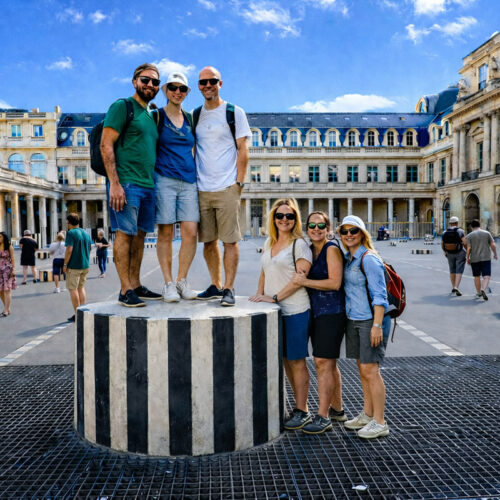
Just beyond the historic arcades of the Palais-Royal, one of Paris’s most striking contrasts awaits: Daniel Buren’s black-and-white columns, known as Les Deux Plateaux. Set within a classical courtyard, this contemporary installation creates an unexpected dialogue between royal architecture, modern art, and playful perspective — a detail that often intrigues travelers and makes the Palais-Royal feel wonderfully different from the more familiar monuments of Paris.
Walking through Les Halles, you move through more than just a neighborhood: you navigate the ebb and flow of Parisian history itself. The sensory experience is striking—the smooth stone of Saint-Eustache’s soaring vaults contrasts with the modern aluminum and glass of the Canopée above, while street-level cafés spill their aromas into the breeze.
Take time to pause beneath the Church’s intricate carvings, sending your gaze upwards where centuries of faith and craftsmanship meet. Venture into the Forum des Halles to observe how contemporary commerce thrives in a space once dedicated to raw foods and barter. Nearby, the Bourse de Commerce reveals a dialogue between Paris’s past and the present international art scene, a place where light and space kindle reflection and wonder.
At the Palais-Royal, your exploration deepens. Here, history is a puzzle waiting to be solved. Engage with an interactive investigative game that draws you into tales of royal secrets, revolutionary fervor, and Parisian intrigue. It’s a playful, insightful way to discover layers usually hidden behind elegant façades and manicured gardens.
The game spans the sumptuous galleries and serene gardens, inviting you to interpret clues woven into the architecture, artworks, and stories passed down through centuries. It offers a rare chance to connect emotionally with the space—to become not just an observer, but a participant in Paris’s unfolding drama.
In Les Halles, the past reveals itself in subtle ways. Notice the faint outlines of the long-gone Baltard pavilions traced in some remaining structures, and sense the rhythm of the old market streets beneath today’s pedestrian pathways. Listen for the quiet hum of the Saint-Eustache organ during midday services, its music a living link to centuries of Parisian life.
Within the Palais-Royal, your attention might be drawn to the delicate latticework in the galleries or the discreet emblems carved into stone that hint at stories of revolution and royal privilege. The sun-dappled gardens, with their carefully aligned trees and statues, invite contemplation on how this space has shifted—from private power to public gathering place.
Amid this layering, the contrast between the hustle and bustle of Les Halles and the contemplative, secluded quality of the Palais-Royal offers a dynamic, sensory-rich experience that few Paris visitors encounter.
Begin your visit early to absorb Les Halles before the crowds swell. The morning light plays beautifully on the church’s façade and the open-air market stalls offer a feast for the senses. Comfortable walking shoes are essential—the district’s charm lies in its labyrinth of streets, covered passages, and unexpected viewpoints.
The most memorable discoveries in The Belly of Paris, Les Halles & an Investigation at the Palais-Royal are often found in the details that many visitors pass too quickly: a quiet façade, a historic name, a staircase, a garden, a view, or a trace of the people who shaped the place long before it became famous.
Suite Voyage Discovery helps you connect those small details to the larger story of Paris, turning a beautiful visit into a more personal and meaningful experience.
To enjoy The Belly of Paris, Les Halles & an Investigation at the Palais-Royal at its best, give yourself time to slow down. The most rewarding moments often appear between the famous sights: a quiet street, a changing light, a café terrace, a hidden architectural detail, or a viewpoint you might miss when rushing.
Suite Voyage Discovery can shape the timing and rhythm of your visit so the experience feels comfortable, personal, and beautifully connected to the rest of your stay in France.
The most memorable journeys rarely come from a checklist. They come from a rhythm, a mood, a sequence of places that feels natural to you — a morning in a historic neighborhood, an afternoon among masterpieces, a quiet view over Paris, or a countryside escape woven into the same journey.
With Suite Voyage Discovery, every itinerary is crafted around your interests, your pace, and the kind of memories you want to bring home.
Timing your Palais-Royal investigation to coincide with a visit to its gardens allows for immersive contrast, between active discovery and quiet reflection. Don’t miss the chance to stop at one of the historic cafés bordering the arcades; here the mood swings from intellectual to playful, just as it has for centuries.
This is also where a personalized Paris itinerary begins to feel different. Suite Voyage Discovery can shape the experience around the rhythm you prefer — a quiet morning walk, a deeper art-focused route, or a day that connects neighborhood charm with the city’s great landmarks, such as the Louvre Museum, Notre-Dame de Paris, or the Eiffel Tower.
Les Halles and the Palais-Royal sit at the crossroads of many Parisian narratives. To deepen your journey, consider wandering to nearby jewel-like neighborhoods such as the Marais or Saint-Germain-des-Prés, where history, art, and café culture continue to coax travelers into immersive discovery.
The area invites you to thread the past and present, connecting medieval market life and royal exclusivity with the creative pulse of contemporary Paris. Stop by the Centre Pompidou for a modern architectural marvel and artistic exploration—currently under renovation but still commanding attention—or enjoy an evening at the nearby famous cabarets like the Moulin Rouge, Evening at the Moulin Rouge in Paris: show, champagne or dinner, and legendary cabaret, for a blend of history and entertainment.
For travelers who want more than a standard visit, Suite Voyage Discovery turns places like this into meaningful chapters of a tailor-made journey through France, balancing iconic sights with quieter moments that feel entirely your own.
Build a richer tailor-made journey by connecting this experience with other carefully selected Suite Voyage Discovery programs.
Whether this becomes your first morning in Paris or one memorable chapter in a longer journey across France, Suite Voyage Discovery can craft the experience around what you want to see, feel, and understand.
Les Halles earned the nickname "belly of Paris" because it served as the city’s central food market for over 800 years, supplying Parisians with fresh produce, meats, and goods. It was literally the place that nourished Paris, a bustling hub where the city’s culinary life was organized.
The visit spans from the medieval origins of Les Halles in the 12th century, through its 19th-century transformation under the Baltard pavilions, the 20th-century urban renewal with the Forum des Halles and Canopée, to the present-day cultural landscape including the Bourse de Commerce’s modern role.
The Palais-Royal stands out as a former royal residence turned vibrant social and artistic hub. Its arcades and gardens have witnessed political intrigue, revolutionary debates, and artistic gatherings, making it a crossroads of Paris’s cultural and historical evolution, now enhanced with an immersive investigative game deepening its narrative.
Few places bring you as close to an artist’s way of seeing as Giverny. Claude Monet lived and worked here from 1883…
Step away from Paris's well-trodden paths, and the 13th arrondissement gently unfolds a story of transformation — where the past’s industrial grit…
This tour offers groups an immersion into the heart of historic Paris, between the preserved charm of the Marais and the discreet…
Would you like to plan a similar experience? Request your personalized itinerary.