Guided Tour of the Eiffel Tower and Trocadéro – A Different View of the Eiffel Tower
Eiffel Tower & Trocadéro – Monumental Paris A universal symbol of Paris, the Eiffel Tower is far more than its outline. Around…
Stock up of discoveries
Discover the most beautiful historical monuments of our heritage
Go alone or in a group to discover these places
You won't miss a single detail - they know their subject inside out.
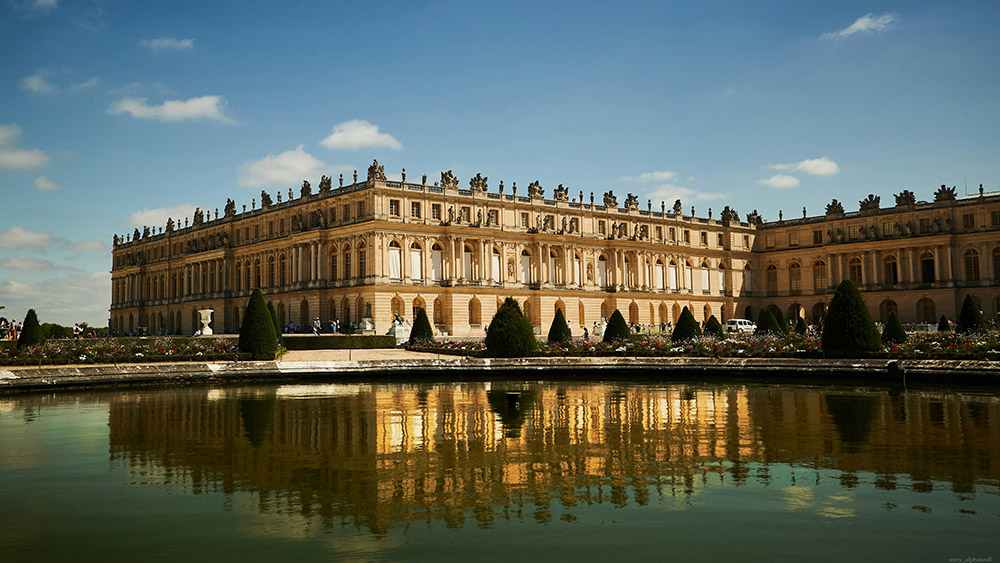
Versailles is where architecture, ritual, and landscape fused into a single theater of power—and where world history repeatedly returned to the same stage. On May 6, 1682, Louis XIV installed his court and government here, transforming a royal hunting retreat into the nerve center of the French monarchy.
Inside the palace, the King’s and Queen’s Grand Apartments, the King’s Bedchamber, and the Hall of Mirrors reveal how art and ceremony were used to project royal authority. Outside, André Le Nôtre’s gardens extend the same vision into the landscape through monumental perspectives, formal parterres, hidden groves, fountains, and reflecting pools.
With Suite Voyage Discovery, an expert guide helps you understand Versailles as it was designed to be experienced: through the symbolism of the royal apartments, the choreography of court life, the spectacle of the Hall of Mirrors, and the carefully controlled geometry of the gardens. Your visit is shaped around your interests, available time, and preferred pace, with the palace as its anchor and the gardens—and, if desired, the Trianon Estate—as natural extensions.
Click a photo to enlarge
Versailles established a model for royal residences throughout Europe. Its influence extended far beyond architecture. The palace brought together political authority, court ceremony, decorative arts, theater, music, fashion, and landscape design in an environment where almost every detail communicated the power of the monarchy.
Louis XIV entrusted the transformation of Versailles to some of the greatest artists of his age. Architect Louis Le Vau enlarged the earlier residence, Jules Hardouin-Mansart gave the palace much of its monumental form, Charles Le Brun directed its decorative language, and André Le Nôtre created gardens whose scale and perspectives redefined the art of landscape design.
Yet Versailles is not frozen in the reign of the Sun King. Louis XV and Louis XVI continued to transform and inhabit the estate. Marie Antoinette created a more personal world around the Petit Trianon and Queen’s Hamlet. After the monarchy, the palace became a museum of French history and later witnessed events that reshaped Europe and the wider world.
A guided experience connects these different layers without turning the visit into a chronological history lesson. The goal is to understand what you see, how the spaces functioned, and why Versailles remains one of the world’s most influential cultural landmarks.
Versailles did not begin as a political capital. Louis XIII appreciated the area for hunting and built a modest lodge, later replaced by a small château of brick and stone. His son, Louis XIV, became deeply attached to the residence and began transforming it during the 1660s.
Rather than demolishing his father’s château completely, Louis XIV preserved its central structure and surrounded it with new construction. This architectural development, sometimes described as an “envelope,” remains visible in the contrast between the intimate courtyard façades and the grander elevations overlooking the gardens.
On May 6, 1682, Louis XIV formally established his court and government at Versailles. The palace became the political heart of the kingdom, housing not only the royal family and courtiers but also ministers, administrators, officers, servants, and visitors seeking access to the sovereign.
The decision transformed Versailles into a unique social environment. Noble families competed for rooms, invitations, offices, and moments of proximity to the King. Architecture and etiquette worked together: where a person could stand, which doorway they might cross, and which ceremony they were permitted to attend all reflected their position at court.
Versailles was designed to make royal authority visible. Approaching through its succession of courtyards, visitors were gradually drawn toward the King’s residence. Inside, antechambers, salons, galleries, and ceremonial rooms created an increasingly controlled progression toward the person of the monarch.
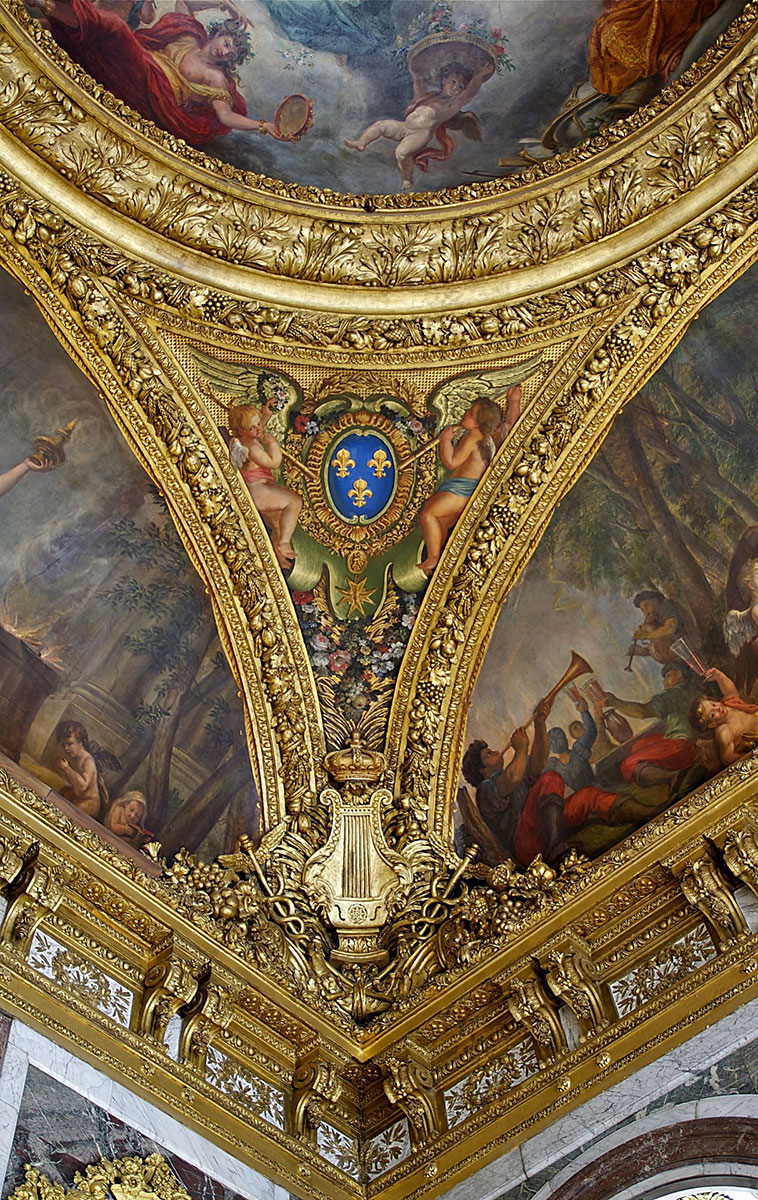
Charles Le Brun’s decorative program transformed mythology into political language. Images of Apollo, the sun god, echoed Louis XIV’s chosen identity as the Sun King. Painted ceilings celebrated military victories, prosperity, royal protection of the arts, and the idea of a kingdom ordered around its sovereign.
An expert guide helps make this language accessible. Mythological figures, royal emblems, painted allegories, and architectural details cease to be isolated ornaments. Together, they reveal how Versailles communicated its message to courtiers, ambassadors, and visitors from across Europe.
At Versailles, etiquette was more than a collection of elaborate manners. It organized access to the King and turned everyday actions into political rituals. The lever and coucher—the King’s ceremonial rising and retiring—determined who could enter his presence and at what stage of the proceedings.
Helping the King dress, presenting an object, or simply being admitted to a particular room could represent a significant honor. By distributing these privileges, Louis XIV encouraged the nobility to remain close to court and compete for royal favor.
The arrangement of the palace supported this system. Rooms were designed for watching and being watched. Doors, sightlines, barriers, and sequences of antechambers helped regulate proximity to the sovereign. Understanding these practices allows visitors to see the apartments not simply as beautiful interiors but as parts of a functioning political system.
The King’s and Queen’s Grand Apartments form the ceremonial heart of Versailles. Their painted ceilings, marble, gilded ornament, sculptures, textiles, and formal arrangement reveal the grandeur expected of Europe’s most powerful royal court.
In the King’s Grand Apartment, a sequence of salons named after ancient gods and goddesses creates a mythological universe around the sovereign. The rooms hosted receptions, music, dancing, games, and the celebrated evening gatherings known as soirées d’appartement.
The Queen’s Grand Apartment reflects the official role of France’s successive queens. Its most famous room is the Queen’s Bedchamber, occupied at different times by Maria Theresa of Spain, Marie Leszczyńska, and Marie Antoinette. Royal births took place here in the presence of witnesses, ensuring that the legitimacy of the succession could not be disputed.
The King’s Bedchamber occupied a central place in the ceremonial life of the palace. Its position reinforced the symbolic organization of Versailles around Louis XIV. The room was both personal and public: the King slept there, but his rising and retiring were governed by ritual and attended by selected members of the court.
Seen with these customs in mind, the bedchamber becomes far more than a richly decorated room. It illustrates how Versailles blurred the boundary between private life and public authority, making the sovereign’s daily existence part of the government of the kingdom.
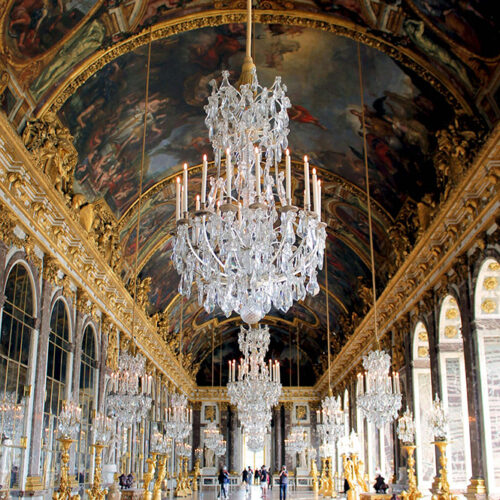
The visual and ceremonial climax of the palace is the Hall of Mirrors, or Galerie des Glaces. Stretching approximately 240 feet, the gallery features 17 mirrored arcades facing 17 windows overlooking the gardens. Its 357 mirrors capture the changing daylight and multiply the perspectives created by André Le Nôtre outside.
Designed by Jules Hardouin-Mansart to replace an open terrace exposed to the weather, the gallery extends between the War Room and the Peace Room, connecting the ceremonial apartments of the King and Queen. The mirrors were more than a spectacular decorative device. At a time when the manufacture of large mirrors was technically demanding and closely associated with Venice, their presence also demonstrated the ambitions and craftsmanship of France under Louis XIV.
Above, Charles Le Brun’s painted compositions celebrate the political, military, and economic achievements of the King’s early personal reign. Marble, gilded bronze, painted ceilings, reflected light, and views of the gardens combine to create a space intended to impress foreign ambassadors and members of the court.
The Hall of Mirrors later witnessed two events with consequences far beyond France. On January 18, 1871, following France’s defeat in the Franco-Prussian War, William I of Prussia was proclaimed German Emperor in the gallery.
On June 28, 1919, representatives of Germany and the principal Allied powers signed the Treaty of Versailles in the same room. The fighting had already ended with the Armistice of November 11, 1918; the treaty established the terms of peace with Germany and profoundly influenced international relations in the decades that followed.
These events give the gallery an extraordinary historical depth. A room created to celebrate Louis XIV later became the setting for both the emergence of a unified German Empire and the postwar settlement imposed upon it nearly half a century later.
For American visitors, Versailles also holds an important place in the history of the United States. On March 20, 1778, Benjamin Franklin was formally received by Louis XVI at the Palace of Versailles, following the signing of treaties between France and the young American republic.
Franklin was already admired in France as a scientist, philosopher, and representative of Enlightenment ideals. His appearance at court became a celebrated moment. Standing before one of Europe’s most powerful monarchs, he represented a new nation seeking recognition and support in its struggle for independence.
The Franco-American alliance brought the United States military, naval, financial, and diplomatic assistance. French participation—including the expeditionary force led by the Comte de Rochambeau and the decisive naval intervention of Admiral de Grasse—contributed to the American victory at Yorktown in 1781.
The peace agreements signed on September 3, 1783, require an important distinction. The treaty through which Great Britain formally recognized the independence of the United States was signed in Paris. Separate treaties between Great Britain and France, and between Great Britain and Spain, were signed at Versailles on the same day.
Together, these agreements brought the conflict to a diplomatic conclusion and reshaped the Atlantic world. They also confirmed the importance of the relationship established between France and the United States during the American Revolution.
This connection adds another dimension to a visit for travelers from the United States. Versailles was not only the residence from which Louis XVI governed France; it was also one of the places where the diplomatic and political relationship between France and the new American republic entered history.
Tell us how you would like to experience the palace, the gardens, and—if you wish—the Trianon Estate. We will shape a guided visit with an expert guide around your time, interests, and preferred pace.
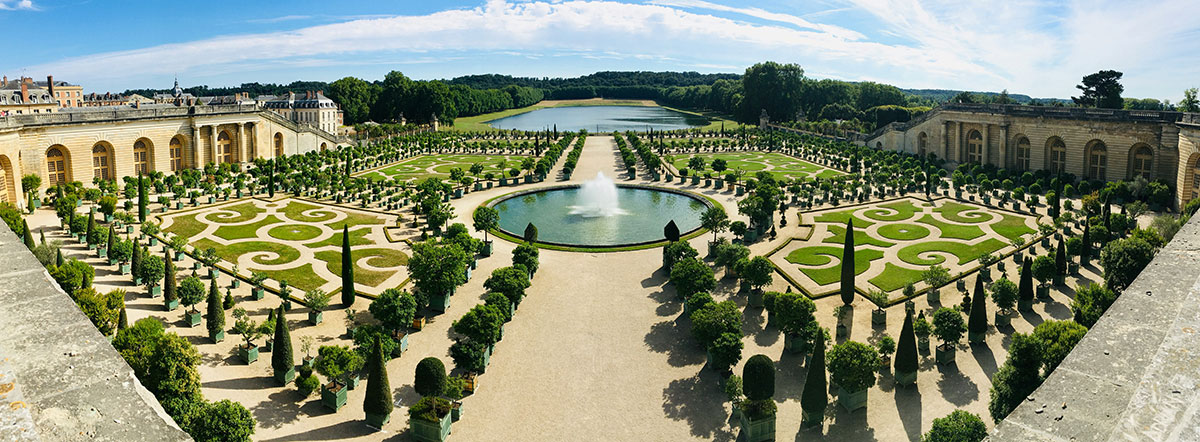
From the palace, the gardens appear to continue the building into the landscape. This effect is intentional. Beginning in 1661, André Le Nôtre projected the palace’s principles of order, symmetry, and perspective onto the surrounding land.
Formal parterres close to the château create intricate patterns best appreciated from the palace windows and terraces. Beyond them, monumental axes carry the eye toward the horizon, while reflecting pools and fountains punctuate the composition.
Yet the gardens are not simply an exercise in rigid geometry. Secondary paths lead into groves, or bosquets, designed as distinct outdoor rooms. Hidden behind walls of greenery, these spaces provided settings for music, dancing, dining, conversation, and court entertainment.
The alternation between open perspectives and enclosed groves gives the gardens much of their emotional power. Visitors move from expansive views to intimate spaces, from bright parterres to shaded paths, and from apparent order to carefully planned surprise.
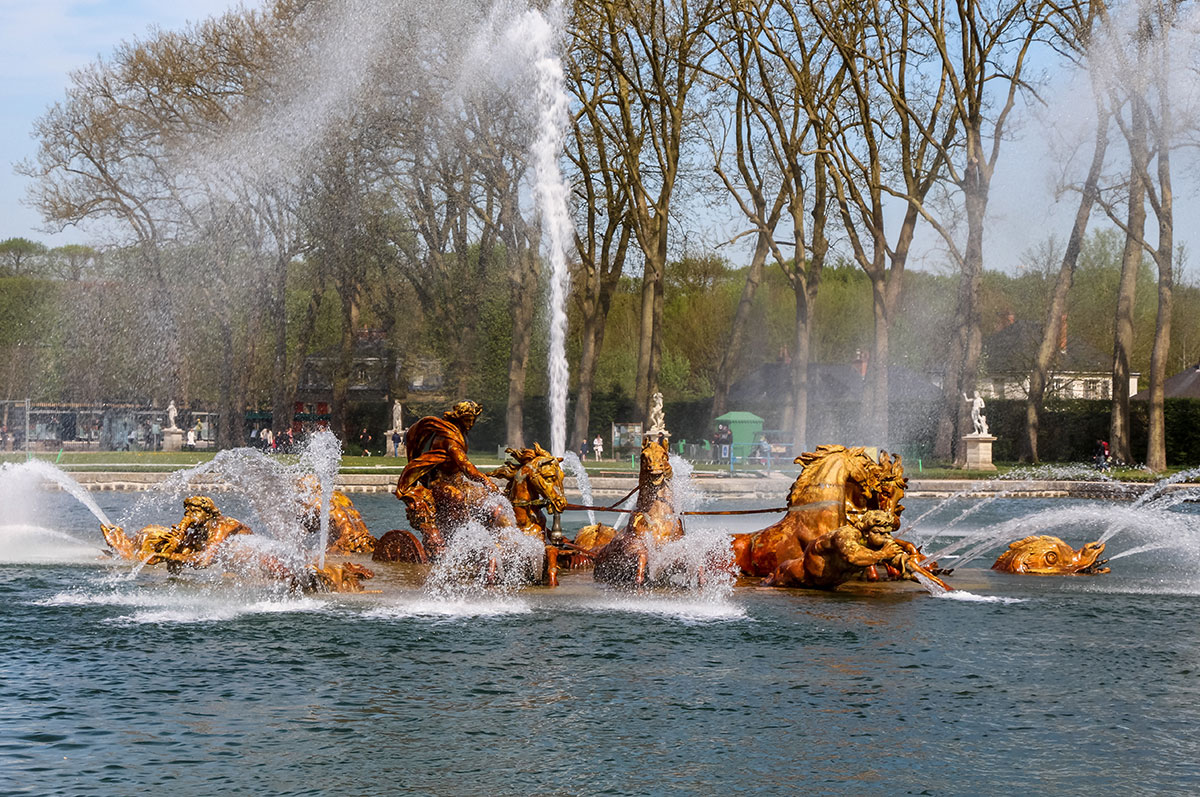
Water plays a central role in the gardens. The Latona Fountain, Apollo Fountain, Neptune Fountain, and numerous smaller basins animate the perspectives and reflect the changing sky.
The figure of Apollo is especially important. As the god of the sun, he was closely associated with Louis XIV’s royal image. In the Apollo Fountain, the god rises from the water in his chariot, creating a powerful link between mythology, landscape, and the identity of the Sun King.
On certain event days, the Musical Fountains shows and Musical Gardens bring additional movement and Baroque music to the landscape. Some groves that are normally closed may be accessible, while fountain operations follow schedules that vary by season and date. Your program is adapted to the conditions and openings available on the day of your visit.
The program is designed around the parts of Versailles that matter most to you. A first experience may focus on the King’s and Queen’s Grand Apartments, the King’s Bedchamber, and the Hall of Mirrors. This sequence provides a coherent introduction to court life, royal symbolism, and the palace’s ceremonial organization.
When time and conditions allow, the visit can continue into Le Nôtre’s gardens. An expert guide reveals how the main perspectives, parterres, groves, basins, and fountains extend the message of the palace into the landscape.
For a more complete day, the Trianon Estate can be added. The exact route depends on the selected date, opening conditions, events, conservation requirements, and the amount of time available. Suite Voyage Discovery organizes the experience to create a realistic and enjoyable balance between the different parts of the estate.
Versailles became the seat of court and government in 1682. Louis XIV’s decision to settle permanently at the palace transformed a royal retreat into the political center of the kingdom.
The Hall of Mirrors contains 357 mirrors. They are arranged across 17 arcades facing the same number of windows overlooking the gardens, creating a spectacular dialogue between interior light and landscape.
Two world-changing political events unfolded in the same gallery. William I was proclaimed German Emperor there in 1871. In 1919, the peace treaty between Germany and the principal Allied powers was signed there, after the Armistice had ended the fighting in November 1918.
The Trianon Estate brings together several periods of royal history. The Grand Trianon was built in 1687, the Petit Trianon was completed during the reign of Louis XV and given to Marie Antoinette in 1774, and the Queen later commissioned her Hamlet in the 1780s.
If the central palace was a world of visibility and ceremony, the Trianon Estate offered a degree of retreat. Its buildings and gardens reveal the sovereigns’ search for spaces removed from the constant public rituals of court life.
The Grand Trianon was built in 1687 by Jules Hardouin-Mansart on the site of the earlier Porcelain Trianon. Its elegant single-story architecture, pink marble, open colonnade, and close relationship with the gardens create a markedly different atmosphere from the main palace.
The Petit Trianon was constructed during the reign of Louis XV by Ange-Jacques Gabriel. In 1774, Louis XVI gave the residence to Marie Antoinette, who developed it as a personal domain governed less directly by the etiquette of Versailles.
Marie Antoinette transformed the surrounding gardens and later commissioned the Queen’s Hamlet, a picturesque group of rustic-inspired buildings arranged around a lake. The ensemble reflected the late 18th-century taste for idealized rural landscapes and a more informal relationship with nature.
The Hamlet should not be understood as an ordinary peasant village. It was a carefully designed royal environment combining visual pleasure, fashionable ideas about rural life, and genuine agricultural activity in parts of the estate.
Including Trianon and the Hamlet allows visitors to encounter another side of Versailles: one of personal taste, changing fashions, and a desire for intimacy beyond the formal world of the Grands Appartements. Because of the distances involved, this extension is best suited to a full-day experience.
In October 1789, the royal family left Versailles for Paris, and the palace ceased to function as the principal residence of the monarchy. Its future remained uncertain during the French Revolution, and much of its furniture was dispersed, but the buildings escaped destruction.
During the 19th century, King Louis-Philippe transformed part of Versailles into a museum dedicated “to all the glories of France.” Inaugurated in 1837, the museum gave the palace a new national purpose and helped preserve it as a place of collective memory.
In 1979, the Palace and Park of Versailles were inscribed on the UNESCO World Heritage List in recognition of their outstanding universal value. Today, Versailles remains a living cultural institution devoted to conservation, research, exhibitions, performances, and the presentation of its collections to visitors from around the world.
Versailles can be experienced over a half day or a full day. A half-day program generally concentrates on the palace’s essential rooms and, when feasible, a first discovery of the gardens. This format offers a strong introduction without attempting to cover an estate whose scale makes an exhaustive visit impossible.
A full day allows a more comfortable combination of palace and gardens. Depending on your interests and the conditions of access, the program may also include the Grand Trianon, Petit Trianon, and Queen’s Hamlet.
Versailles is one of France’s most visited historic sites, and its popularity requires thoughtful planning. Timed admission, seasonal events, conservation work, and varying access to certain gardens or apartments may influence the route. An expert guide provides a clear narrative through the palace and helps maintain a coherent experience even when conditions require adjustments.
The scale and visual richness of Versailles can be overwhelming. Without a clear thread, it is easy to move through celebrated rooms while missing the ideas that connect them.
An expert guide explains the purpose of the apartments, identifies the symbols associated with Louis XIV, and places the painted ceilings and mythological figures in context. The Hall of Mirrors becomes more than an impressive room, and the gardens become more than a beautiful setting.
Guided interpretation also helps distinguish between the different periods represented at Versailles. The palace of Louis XIV, Marie Antoinette’s Trianon, the Revolutionary departure of the royal family, and the diplomatic events of 1871 and 1919 belong to different stories. A guide connects them without allowing one episode to obscure the experience of the place itself.
A visit to Versailles becomes even more meaningful when placed in conversation with other major French residences. At the Château de Vaux-le-Vicomte, travelers can discover the groundbreaking collaboration of Louis Le Vau, Charles Le Brun, and André Le Nôtre before the three artists went on to play decisive roles in the transformation of Versailles.
The Château de Fontainebleau offers a different perspective on French royal life. Shaped by generations of sovereigns, it reveals how royal architecture and artistic taste evolved long before—and continued beyond—the age of Louis XIV.
Exploring these estates together shows that Versailles did not emerge in isolation. It belongs to a much longer history of royal residences, artistic experimentation, court life, and landscape design, while remaining unequaled in the scale and influence of its achievement.
Tell us what you would most like to explore—the palace, the gardens, and, if you wish, the Trianon Estate—and we will shape a guided experience around your interests, time, and preferred pace.
Versailles impresses through its scale, mirrors, gilded decoration, fountains, and seemingly endless perspectives. Its deeper power, however, emerges when these elements are understood together.
The royal apartments reveal how ceremony structured the court. The King’s Bedchamber shows how personal life became public ritual. The Hall of Mirrors turns light and movement into political spectacle. The gardens carry the palace’s message into the landscape, while Trianon offers a revealing contrast between royal display and the desire for retreat.
To visit Versailles with these connections in mind is to move beyond a succession of famous rooms. The palace becomes a living environment shaped by sovereigns, courtiers, artists, diplomats, and the great events that unfolded within its walls.
At the end of the experience, Versailles remains magnificent—but it is no longer incomprehensible. Its architecture, rituals, gardens, and historical layers come together as parts of one extraordinary story.
The experience is built around the palace’s most emblematic spaces: the King’s and Queen’s Grand Apartments, the King’s Bedchamber, and the Hall of Mirrors. When time and conditions allow, the visit continues into André Le Nôtre’s gardens. The exact program is adapted to your available time, interests, pace, and the spaces accessible on your chosen date.
Yes. The Grand Trianon, Petit Trianon, and Queen’s Hamlet can be added to a palace-and-gardens program. Because of the size of the Versailles estate and the distances involved, this extension is best suited to a full-day experience and remains subject to opening conditions on the selected date.
Benjamin Franklin was formally received by Louis XVI at Versailles in 1778 after France entered into treaties with the United States. French military, naval, financial, and diplomatic support contributed to the American victory. In 1783, Great Britain recognized American independence through a treaty signed in Paris, while separate agreements with France and Spain were signed at Versailles on the same day.
Eiffel Tower & Trocadéro – Monumental Paris A universal symbol of Paris, the Eiffel Tower is far more than its outline. Around…
Saint-Germain-des-Prés: Where the Idea of the Left Bank Was Born Few Paris neighborhoods carry as much cultural mythology as Saint-Germain-des-Prés. Its name…
Paris keeps its past in plain sight, and nowhere does the city read more clearly than in the Marais. Here, an early‑17th‑century…
Would you like to plan a similar experience? Request your personalized itinerary.