Arc de Triomphe and the Champs-Élysées: Discover Paris’ Most Famous Avenue
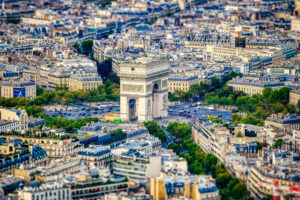
Standing proudly at the top of the Champs-Élysées, the Arc de Triomphe is one of the most recognizable monuments in France and…
Fill up on discoveries
The discovery promenade will be guided for everyone.
Go alone or in a group to discover these places
You won't miss a single detail - they know their subject inside out.
Montmartre is one of those neighborhoods you feel you know before you ever arrive. The Sacré-Cœur, the painters on Place du Tertre, the stairways, cafés, and little houses clinging to the Butte compose a scene that is instantly recognizable.
Yet behind this postcard image lies a far richer story: that of a former village on Paris’s doorstep, a landscape of windmills and vines, a place of popular festivities that became one of the great hubs of artistic creation at the end of the 19th and the beginning of the 20th century.
This guided tour of Montmartre leads you from the Abbesses neighborhood up to the very top of the Butte. Street by street, your guide brings back to life the Montmartre of dance halls, painters, songwriters, and cabarets—along with the residents who helped preserve the neighborhood’s singular identity.
A walk where you slip continually between working‑class Paris and the Paris of artists, from local history to major artistic currents, and from village‑like lanes to one of the capital’s finest panoramas.
From Abbesses to Sacré-Cœur, explore places that tell the story of the village, its artists, and the history of the Butte.
A gateway into living, breathing Montmartre
Montmartre of windmills, dance halls, and the Impressionists
The rural memory of the Butte
Artists’ studios and village houses
Montmartre of the painters
The top of the Butte and the panorama over Paris
Plan your guided tour of Montmartre
A stroll tailored to your pace and interests. Add, if you wish, a gourmet break, lunch, or other Paris discoveries.
Before it was one of the capital’s most famous quarters, Montmartre long stood apart, developing on and around a hill overlooking Paris.
Topography explains much of its character. The slopes, the footpaths that became streets, the stairways, and the irregular plots left their mark here—and the Haussmann-era transformations erased less of that imprint than elsewhere.
It’s this feeling of a city within the city that draws people to Montmartre.
In the 19th century, however, the Butte changed rapidly. Paris expanded, the area grew denser, and a population of workers, small artisans, shopkeepers, and artists settled in. Relatively accessible rents, along with cafés, dance halls, and studios, created an environment that gradually attracted painters, writers, and songwriters.
Montmartre’s artistic identity is not a backdrop invented for visitors: it was born of the encounter between a working‑class territory and an extraordinary creative ferment.
The visit can begin around Place des Abbesses, one of the best entry points for understanding Montmartre.
Here, the bustle of the contemporary neighborhood still rubs shoulders with many traces of its past. Just steps away, Square Jehan‑Rictus is home today to the Mur des Je t’aime, where the phrase is written in a great many languages.
Rather than heading straight up to the Sacré‑Cœur, the route leads into the streets of the Butte.
This is where Montmartre best reveals its singularity: behind a lively street, an alleyway, an old house, a flight of steps, or a perspective appears—reminders of the former village.
Climbing toward rue Lepic and the upper slopes of the Butte, you come upon one of old Montmartre’s great symbols: its windmills.
They were once numerous on the hill. Some ground grain; others crushed different materials. Two have survived the centuries and are linked to the story of the famed Moulin de la Galette.
The Blute‑Fin, whose origins go back to the 17th century, was transformed in the 19th century into a place of entertainment. People came to drink, eat galettes, and above all dance. The popular atmosphere of the dance hall inspired the artists who lived or worked in Montmartre.
In 1876, Auguste Renoir immortalized this spirit in his celebrated Bal du moulin de la Galette, now held at the Musée d’Orsay. More than a picturesque scene, the painting captures the light, movement, and sociability of a popular pleasure spot that became one of Impressionism’s emblematic images.
That is the heart of this visit: linking the places you pass through with the works and artists who forged the Montmartre myth.
Renoir is hardly the only artist associated with the Butte.
At different times, painters, illustrators, writers, and musicians found here an environment conducive to creation. Modest studios, cafés, cabarets, and inexpensive lodgings encouraged encounters.
Montmartre thus became a remarkable artistic laboratory.
Still, it would be misleading to imagine a neighborhood populated solely by bohemian painters. The artists’ Montmartre coexisted with that of workers, shopkeepers, washerwomen, artisans, and small industries.
This coexistence gave the area a special energy and helps explain why so many artists found their subjects here.
A few streets farther on, an unexpected sight appears: an actual vineyard in the heart of Paris.
The vine has long grown on the Montmartre hillsides, but today’s Clos Montmartre is much more recent. In the early 1930s, local residents mobilized to prevent construction on an empty plot. Vines were planted there in 1933, and the first harvest festivities followed in 1934. The tradition continues today.
The Clos thus recalls both the Butte’s rural past and the attachment Montmartre’s residents feel for their neighborhood.
Nearby, rue Cortot extends this almost village‑like atmosphere. The Musée de Montmartre occupies the Maison du Bel Air, one of the Butte’s former residences. Renoir lived there in 1875 and 1876 and painted several important works. Today’s Renoir Gardens preserve that memory.
The walk then reaches streets that helped shape the neighborhood’s image.
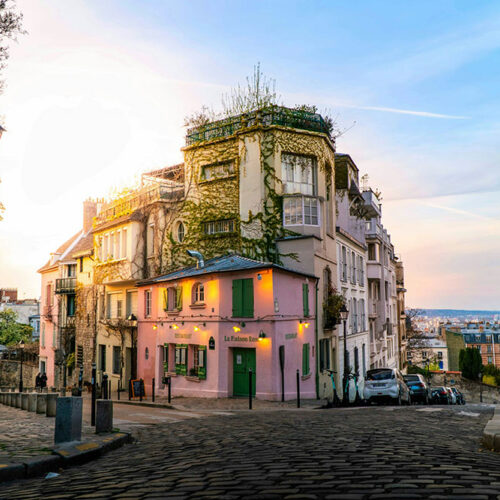
Around rue de l’Abreuvoir, low houses and vistas can still at times make you feel far from the heart of a major capital.
Montmartre is nevertheless a place where you have to tell history from legend.
Its image was built as much by artists’ works as by songs, photographs, cinema, and tales of Parisian bohemia. In a way, each generation reinvented its own Montmartre.
It is precisely this blend that makes the walk so compelling: the real neighborhood and the dreamed Montmartre are almost impossible to separate.
As you near the summit, Place du Tertre signals a change in atmosphere.
This former village square is now inseparable from the painters and portraitists who work there. The artistic tradition continues daily and remains one of Montmartre’s most familiar images.
The square is very busy, but your guide helps place it in context and see beyond its touristic veneer.
Behind the easels lies the whole story of a neighborhood that gradually became synonymous with creation, freedom, and bohemia.
The walk naturally ends around the Basilica of the Sacré‑Cœur, which crowns Paris from the top of the Butte.
Its construction belongs to a different story than that of painters and cabarets. The project took shape in the troubled climate of the 1870s. Construction was declared of public utility in 1873; Paul Abadie won the architectural competition the following year, and the first stone was laid in 1875.
Work continued for several decades. The First World War delayed the consecration of the building, which finally took place in 1919.
With its Roman‑Byzantine architecture and exceptional position, the basilica has become inseparable from Montmartre’s silhouette.
But the true finale of the walk may lie elsewhere: in the panorama.
From the heights of the Butte, Paris unfolds before you. After winding through lanes, windmills, studios, and memories of the former village, this view makes it clear just how much Montmartre remains a world apart within the capital.
Whether you’re traveling solo, as a couple, with family or friends, or as part of a group, Suite Voyage Discovery adapts your Montmartre tour to your pace and interests.
The route can be adjusted based on mobility and the time you have available. Because Montmartre is naturally hilly and includes several stairways, variants can be planned to make the experience more comfortable.
This walk can be offered on its own or included in a half‑day or full day in Paris, with a gourmet break, lunch, a museum, or another visit.
Request your personalized program
About 2 hours. The timing may vary slightly depending on your pace, stops, and the chosen route.
Montmartre is hilly and some routes include stairways. The itinerary can be adapted to limit difficulties and take participants’ mobility into account.
Exploring the neighborhood and its history is the core of the program. Additional time around the Sacré-Cœur can be considered depending on the plan and access conditions.
Standing proudly at the top of the Champs-Élysées, the Arc de Triomphe is one of the most recognizable monuments in France and…

Step quietly away from the bustling city streets into a sanctuary where centuries-old oaks cast dappled shadows over winding paths, and the…
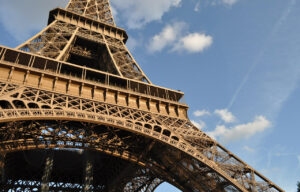
No visit to Paris feels complete without standing beneath the Eiffel Tower. Rising gracefully above the rooftops of the French capital, this…
Would you like to plan a similar experience? Request your personalized itinerary.