Père-Lachaise Cemetery: Discover Paris’ Most Famous Cemetery and Its Legendary Residents
While Paris is famous for landmarks such as the Eiffel Tower, Notre-Dame and the Louvre, the city's largest cemetery offers a completely…
Fill up on discoveries
The discovery promenade will be guided for everyone.
Go alone or in a group to discover these places
You won't miss a single detail - they know their subject inside out.
Just steps from Paris’s major monuments and historic neighborhoods, the Canal Saint‑Martin reveals another face of the city. No palaces here, no sweeping Haussmann boulevards: the scene is set by locks, slender iron footbridges, tree‑lined quays, and former working‑class districts long paced by passing barges.
This guided walk along the Canal Saint‑Martin and the Bassin de la Villette follows the water’s edge to tell two centuries of Parisian change. Created in the early 19th century to improve the capital’s drinking‑water supply and ease navigation, the canal quickly became a key artery of industrial Paris before embracing a new life centered on strolling, culture, and leisure.
From the Canal Saint-Martin’s locks to the wide-open Bassin de la Villette, explore a once working-class, industrial Paris that has become one of the city’s liveliest areas.
How the canal works and 19th-century Paris
A Parisian landscape shaped by water
Working-class Paris and cinema’s imagination
When the octroi marked Paris’s limits
From merchant port to urban leisure
Why did Paris build a canal through the heart of the city? How do boats move between basins at different levels? Why did the Hôtel du Nord become a symbol of Parisian cinema? And how did once‑industrial, working‑class districts turn into some of the capital’s favorite places to walk?
This walk offers a different history of Paris than the one told by its great monuments—the story of water, commerce, labor, urban transformation, and everyday life.
Click a photo to enlarge
The Canal Saint‑Martin has an instantly recognizable identity.
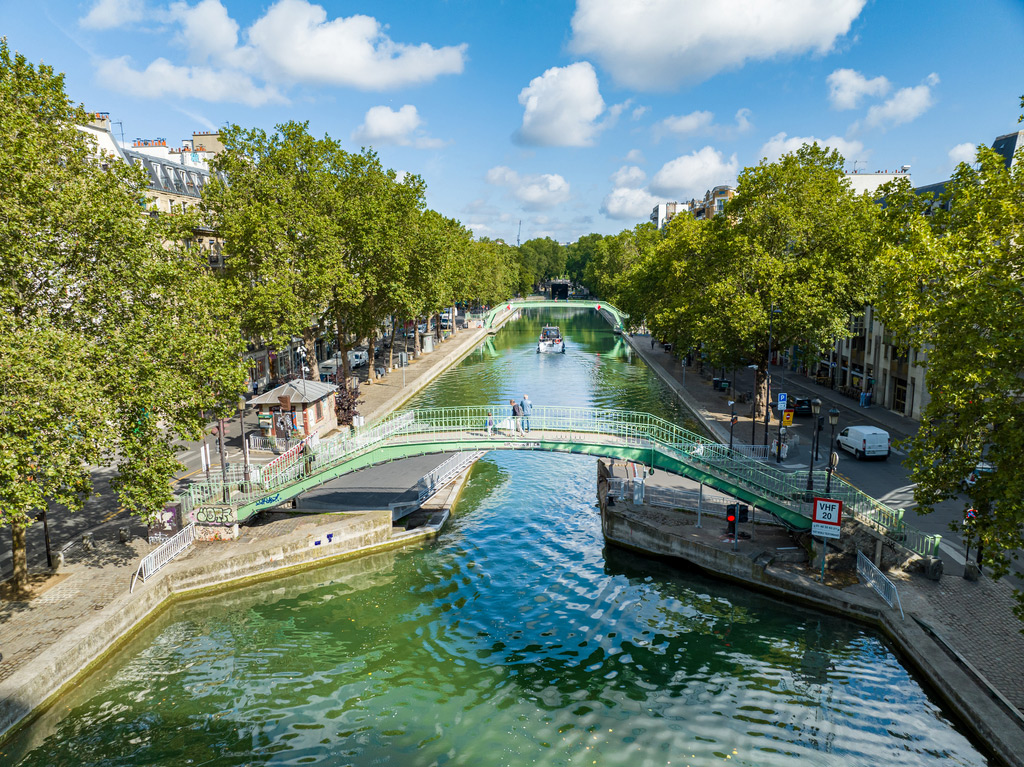
Its locks, iron footbridges, and tree‑shaded quays make for a landscape very different from monumental Paris. Water introduces a different rhythm into the city and opens long perspectives between the apartment blocks.
Yet this setting—now associated with walking and leisure—was born of a far more functional project.
In the early 19th century, Paris was growing rapidly. Supplying the population with drinking water had become essential, as had meeting the needs of trade and freight transport.
Under the Consulate, Napoleon Bonaparte therefore set in motion an ambitious network of canals around the capital.
The Canal Saint‑Martin became one of its essential links.
At the start of the 19th century, access to good‑quality water remained difficult for a large share of Parisians.
The project captured water from the Ourcq and brought it to Paris via a system combining the Canal de l’Ourcq, the Bassin de la Villette, the Canal Saint‑Martin, and the Canal Saint‑Denis.
Decided in 1802, the project faced numerous delays before being completed under the Restoration.
The Canal Saint‑Martin was inaugurated in 1825.
From the outset, the canal was not merely a scenic amenity. It was part of an infrastructure designed to support the growth of a capital in the midst of transformation.
But another function soon took on considerable importance: transport.
For much of the 19th century and into the early 20th, the canals served as major arteries for goods traffic.
Barges carried building materials, timber, grain, and various commodities needed by a city whose population was rising fast.
Warehouses, workshops, and businesses developed along the canal.
This history explains why the surrounding districts retained a strongly working‑class character for so long.
We are far from the Paris of salons, grand mansions, and prestigious avenues. The canal belongs more to the Paris of artisans, workers, shopkeepers, and boatmen.
Walking here reveals an essential, if sometimes lesser‑known, dimension of Parisian history: a city that works, produces, builds, and must be supplied every day.
The locks are among the Canal Saint‑Martin’s most striking features.
They allow boats to gradually overcome the changes in level along the route.
Watching a lock in action makes the principle easy to grasp: the boat enters a chamber closed by gates; the water level then rises or falls until it matches the next section of the canal.
It looks simple enough, yet for two centuries this operation has kept boat traffic flowing across Paris.
Here, technical works are a full‑fledged part of the scenery.
Lock gates and mechanisms, small service buildings, and delicate iron footbridges create a setting that is both industrial and surprisingly tranquil.
Continuing along the quays of Valmy and Jemmapes, the canal reveals one of its most characteristic images.
Slender iron footbridges curve across the water while the quays follow the succession of basins and locks.
Most of these footbridges were installed in the second half of the 19th century, as the canal gradually became a true element of the urban landscape.
They allow residents to cross swiftly from one bank to the other and, even today, offer remarkable viewpoints over the locks.
Yet this setting was not always seen as heritage to be preserved.
In the 20th century, as the automobile loomed ever larger in urban planning, some sections of the canal were under threat. In the 1960s, plans even considered transforming it into a major roadway.
Its survival now feels like a stroke of luck: the canal is one of Paris’s most distinctive urban landscapes.
On the quai de Jemmapes stands a facade now inseparable from the Canal Saint‑Martin’s image: the Hôtel du Nord.
The establishment once served a popular clientele in a neighborhood of workers, artisans, and employees.
But its fame is above all cinematic.
In 1938, Marcel Carné filmed Hôtel du Nord, adapted from Eugène Dabit’s novel. With Arletty and Louis Jouvet among its leads, the film helped cement the canal’s place in the Parisian imagination.
The twist is delicious: most of the scenes were not shot here.
The canal and hotel were recreated in the studio by set designer Alexandre Trauner.
No matter—the power of cinema is such that the real Hôtel du Nord and its neighboring quays are still linked to the film and to that evocation of working‑class Paris in the interwar years.
This stop is a chance to reflect on how cinema also helps shape Paris’s image.
Hôtel du Nord is far from the only film to draw on the area’s distinctive atmosphere.
Since the early days of cinema, water, bridges, locks, and the nearby streets have inspired filmmakers.
This Paris, set apart from the grand avenues, provides a backdrop you can recognize at a glance: a more intimate, everyday, and often more popular city.
Over time, the Canal Saint‑Martin has become a character in its own right in Parisian cinema.
Today’s walker moves through a place where two realities overlap: the real neighborhood and the Paris of films, photographs, and literature.
As you approach the Bassin de la Villette, the scenery shifts.
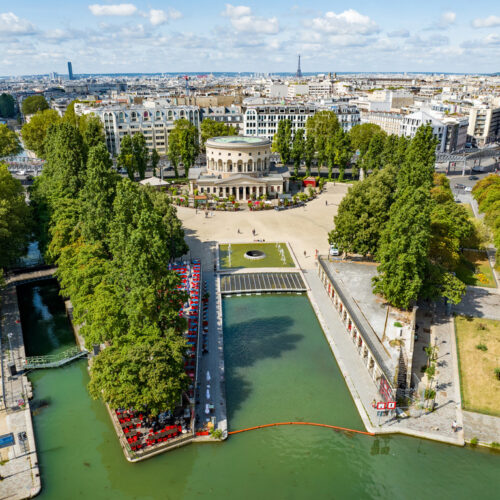
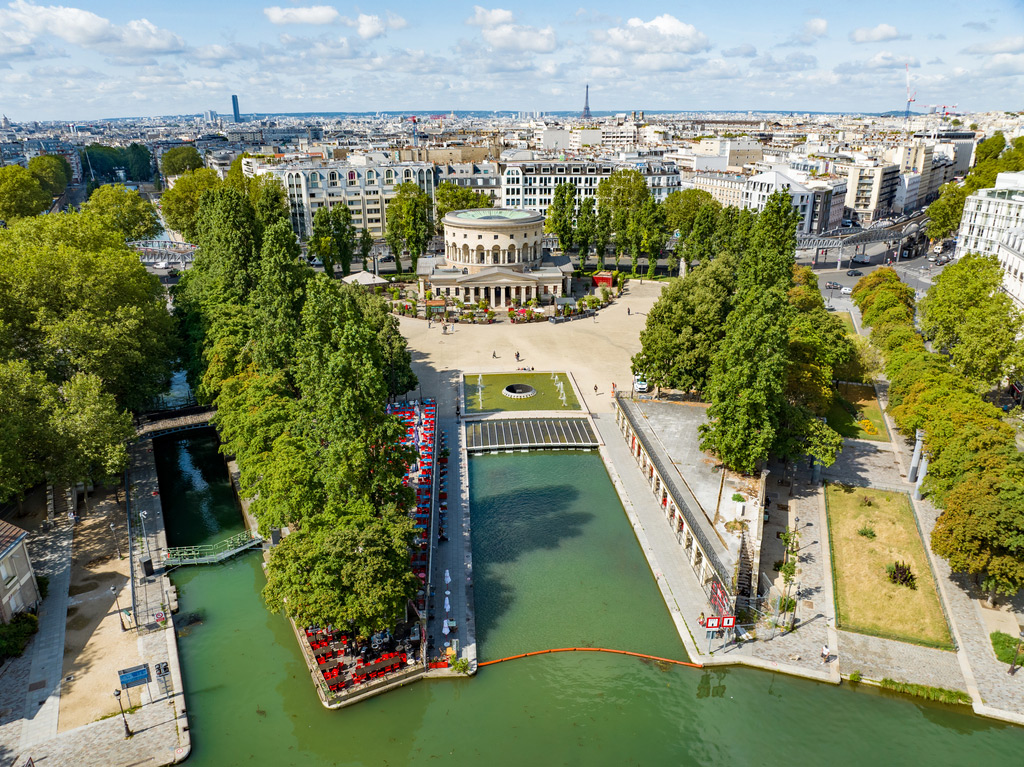
The Rotonde de la Villette, an imposing neoclassical building by Claude‑Nicolas Ledoux, recalls that on the eve of the French Revolution, this was the edge of Paris.
In the 1780s, the wall of the Fermiers généraux encircled the capital.
Unlike earlier military fortifications, this wall was not built for defense.
Its purpose was fiscal.
Goods entering the city had to pay duties, so large barriers were installed at the main crossing points.
Claude‑Nicolas Ledoux designed monumental buildings for these barriers to make the tax authority’s presence visible.
The Rotonde de la Villette is among the few remaining vestiges of this now‑vanished system.
It underscores how dramatically Paris’s limits have shifted: a neighborhood we see today as fully Parisian once stood on the city’s threshold.
After the Canal Saint‑Martin’s more intimate sections, arriving at the Bassin de la Villette brings a spectacular change of perspective.
The water opens out and the view widens.
The basin sits at the junction of several vital waterways: to the south, the Canal Saint‑Martin leads to the Seine; to the northeast, the Canal de l’Ourcq heads deeper into the Paris region.
For a long time, this area had a strongly commercial and industrial vocation.
Boats moved through, goods were handled, and numerous activities clustered around the water.
Close by, the La Villette abattoirs and cattle market reinforced the area’s intense activity in the 19th century and well into the 20th.
Over the course of the 20th century, Paris’s economic balance changed profoundly.
Road transport gradually took over part of river freight. Industries left the capital or disappeared. The La Villette abattoirs closed in 1974.
The vast industrial and logistics sites of northeast Paris then had to find new uses.
Around the basin, the transformations were progressively spectacular.
Where port activity and freight once dominated, new places for strolling, culture, leisure, and gathering emerged.
This shift does not mean the area’s industrial past has vanished.
It remains readable in the neighborhood’s geography, in the basin’s generous scale, in certain buildings, and in the very organization of the canals.
The contemporary landscape thus tells two stories at once: that of industrial Paris fading from view, and that of a new city reinventing itself.
Today, the Canal Saint‑Martin and the Bassin de la Villette have become especially beloved places to live and linger.
Walkers, cyclists, and residents have replaced much of the activity once tied to moving goods.
Restaurants, cafés, cultural venues, and recreational spaces accompany this new direction.
The allure of the area lies precisely in its overlapping eras.
A 19th‑century lock can stand a few steps from a contemporary cultural space. An old industrial facility becomes a promenade. A building once devoted to collecting duties from the Ancien Régime now faces one of Paris’s major leisure basins.
Few districts make it so easy to see how Paris transforms its heritage without erasing its past.
This walk is an excellent alternative to visits focused solely on the great monuments.
The Canal Saint‑Martin tells a more everyday Paris.
Here you talk about drinking water and navigation, workers and goods, urban transformations and cinema.
It also makes clear that Paris was never built all at once.
Across the centuries, its limits shifted, its means of transport evolved, its industrial quarters changed, and strictly utilitarian infrastructure became part of its heritage.
Between the Canal Saint‑Martin’s locks and the wide‑open Bassin de la Villette, you read two centuries of the capital’s evolution—along the water.
This guided walk can stand on its own or serve as a springboard for a broader exploration of northeast Paris.
Depending on the time you have, your interests, and your pace, several extensions let you shape a half day or full day around water, architecture, science, or culture.
Whether you’re traveling solo, as a couple, with family or friends, or as part of a group, Suite Voyage Discovery adapts this Canal Saint‑Martin visit to your interests and pace.
The route can be adjusted to fit your schedule, mobility, and any other visits planned during your stay in Paris.
It can be a stand‑alone two‑hour experience or be woven into a longer half day pairing the walk with a cruise, a gourmet break, or time at the major cultural institutions in La Villette.
Contact us to plan a Canal Saint‑Martin and Bassin de la Villette experience tailored to you.
Yes. It’s particularly well‑suited to associations, clubs, groups of friends, seniors, and companies. The route and timing can be adjusted to the participants’ pace and mobility.
Yes. Depending on schedules, availability, and your group’s composition, a cruise can extend the walk. It lets you see the canal from the water, pass through its locks, and, depending on the itinerary, travel through its underground sections.
You can continue toward the Bassin and Parc de la Villette, the Cité des sciences et de l’industrie, or the Philharmonie de Paris. A snack break or lunch can also be added to shape a half‑day or full‑day discovery.
While Paris is famous for landmarks such as the Eiffel Tower, Notre-Dame and the Louvre, the city's largest cemetery offers a completely…
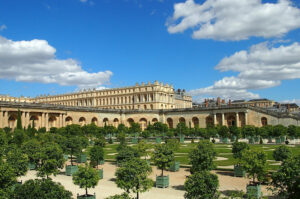
Versailles is where architecture, ritual, and landscape fused into a single theater of power—and where world history repeatedly returned to the same…
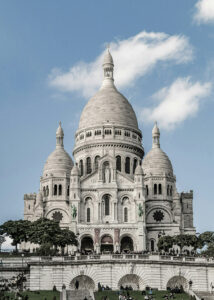
Imagine stepping off the bustling Parisian avenue into a narrow alley where the rhythm slows, and the city’s hum softens into whispers…
Would you like to plan a similar experience? Request your personalized itinerary.