Sainte-Chapelle: Discover Paris’ Most Spectacular Gothic Masterpiece
Located on the historic Île de la Cité in the heart of Paris, Sainte-Chapelle is one of the most breathtaking monuments in…
Stock up of discoveries
Experience full of surprises as your day goes by.
Go alone or in a group to discover these places
You won't miss a single detail - they know their subject inside out.
Few Paris neighborhoods carry as much cultural mythology as Saint-Germain-des-Prés. Its name evokes writers filling notebooks at café tables, philosophers debating freedom and responsibility, jazz escaping from underground clubs, and artists moving between studios, galleries, and late-night conversations. For generations of American visitors, it has represented a particular dream of Paris: intellectual yet sensual, historic yet unconventional, elegant without losing its creative edge.
That image is real, but it tells only part of the story. Long before Ernest Hemingway discovered the literary world of the Left Bank, before James Baldwin came to Paris seeking distance and freedom, and before Miles Davis encountered the city’s passionate jazz audience, Saint-Germain-des-Prés was the domain of one of medieval Paris’s most powerful abbeys.
The neighborhood developed over nearly fifteen centuries. Its surviving church, ancient streets, publishing houses, bookstores, historic cafés, art galleries, and intimate courtyards reveal different layers of the city’s history. Each generation transformed Saint-Germain without completely erasing what came before.
To understand Saint-Germain-des-Prés is therefore to look beyond a collection of famous addresses. It is to discover how a religious settlement outside medieval Paris became a center of scholarship, publishing, artistic experimentation, political thought, and international cultural exchange.
Click a photo to enlarge
The story of Saint-Germain-des-Prés begins in the sixth century, during the rule of the Merovingian kings. Childebert I, a son of Clovis, founded a basilica to house precious religious relics brought from Spain. The church was consecrated in 558 by Germain, bishop of Paris, who was later declared a saint and gave the abbey its enduring name.
The words des Prés mean “of the meadows.” At the time of its foundation, the abbey stood outside the city, surrounded by fields and agricultural land on the Left Bank of the Seine. Paris itself remained concentrated largely around the Île de la Cité and the fortified areas nearby.
The abbey became an important royal institution and served as a burial place for Merovingian rulers before the Basilica of Saint-Denis developed into the principal royal necropolis of France. Endowed with land and privileges, Saint-Germain-des-Prés exercised considerable religious and economic influence over the surrounding territory.
Viking raids devastated the abbey during the ninth century. Reconstruction began around the end of the tenth century under Abbot Morard. Parts of the western bell tower, nave, and transept of the present church date from this period, making them remarkable survivals from the earliest centuries of medieval Paris.
A settlement gradually formed around the abbey. Because it stood outside the medieval walls, the area developed an identity partly distinct from the center of Paris. Religious buildings, gardens, workshops, homes, and commercial activity occupied the land around the monastery.
The abbey complex was once far larger than the church visible today. It included cloisters, chapels, residences, a library, gardens, and numerous dependencies. Most of these structures have disappeared, but their former presence helps explain the layout and historic importance of the neighborhood.
Today, the Church of Saint-Germain-des-Prés is the most important surviving monument of the former abbey. Its architecture reflects centuries of rebuilding and adaptation. Romanesque elements coexist with an early Gothic choir and later decorative campaigns, allowing visitors to read the history of French religious architecture within a single building.
The church’s colorful interior may come as a surprise. During the nineteenth century, the painter Hippolyte Flandrin, a student of Jean-Auguste-Dominique Ingres, created an extensive decorative cycle for the walls. These paintings form a striking dialogue with the much older medieval structure.
The French Revolution brought the abbey’s institutional life to an end. The monastic buildings were confiscated and assigned new uses. Part of the complex was converted into a storage facility for saltpeter, an ingredient used in gunpowder. An explosion in 1794 caused extensive destruction, and much of the former abbey subsequently disappeared.
The church was returned to worship in 1803. After years of neglect and revolutionary damage, it underwent major restoration during the nineteenth century. What survives is not an untouched medieval monument, but a building whose architecture carries the marks of destruction, rescue, restoration, and continued religious life.
Discover the many lives of Saint-Germain-des-Prés
Explore the neighborhood’s medieval heritage, literary legends, artistic landmarks, and American connections through an experience shaped around your interests.
Saint-Germain-des-Prés did not suddenly become intellectual when writers and philosophers began gathering in its cafés. The abbey had been associated with learning for centuries. Its religious community preserved manuscripts, maintained an important library, and participated in the study of history and ancient texts.
During the seventeenth century, the abbey became a major center of Benedictine scholarship under the Congregation of Saint-Maur. Scholars such as Jean Mabillon developed rigorous methods for analyzing and authenticating medieval documents. His work helped establish the foundations of paleography and the modern critical study of historical sources.
These names may be less familiar to American visitors than Sartre or Hemingway, but their presence is essential to the story. The intellectual identity of Saint-Germain was created not in one celebrated postwar decade, but through a much longer tradition of reading, preserving, interpreting, and debating texts.
Centuries later, monks and manuscripts would give way to editors, bookstores, literary magazines, and café conversations. The form changed, but the neighborhood’s association with ideas endured.
Saint-Germain-des-Prés lies between the historic academic world of the Latin Quarter and the political and cultural institutions of central Paris. This location helped make it one of the capital’s most important neighborhoods for books and publishing.
Major French publishing houses established offices in and around the district. Gallimard, Grasset, and Les Éditions de Minuit became part of a dense literary ecosystem that also included translators, critics, journalists, independent bookstores, and periodicals.
Authors could meet an editor, browse a bookstore, attend a reading, and continue a conversation in a nearby café. Books were not isolated products here. They belonged to a social world of arguments, friendships, rivalries, reviews, and political commitments.
For American readers, one of the most meaningful chapters in this history unfolded on the rue de l’Odéon. American bookseller Sylvia Beach operated the original Shakespeare and Company at 12 rue de l’Odéon. Her bookstore and lending library became a gathering place for English-language writers in Paris.
Beach welcomed members of the expatriate literary community, including Ernest Hemingway, F. Scott Fitzgerald, Gertrude Stein, Ezra Pound, and James Joyce. When publishers in Britain and the United States considered Joyce’s Ulysses too controversial, Beach took the extraordinary risk of publishing it in Paris in 1922.
The original bookstore closed during the German occupation and never reopened. It should not be confused with the present-day Shakespeare and Company near Notre-Dame Cathedral, which was founded by George Whitman after the war and later adopted the historic name.
Although Hemingway lived and spent time in several parts of the Left Bank—not exclusively in Saint-Germain—the world around the rue de l’Odéon formed an important part of his Paris. It belonged to the landscape of friendships, books, cafés, and artistic ambition that he later recreated in A Moveable Feast.
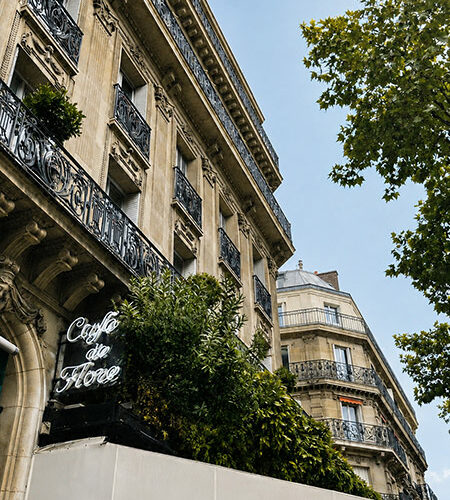
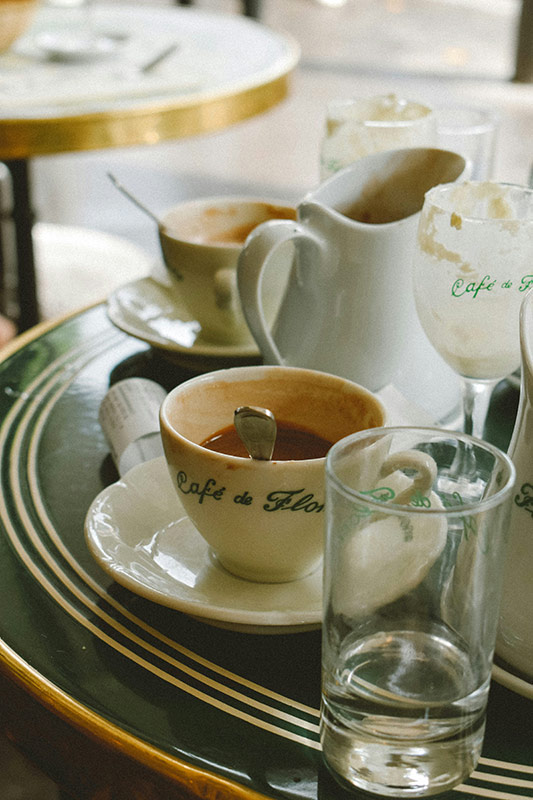
The Café de Flore, Les Deux Magots, and Brasserie Lipp stand near the church and remain among the most recognizable establishments in Paris. Their importance lies not simply in their famous terraces, but in the role cafés once played in the city’s cultural life.
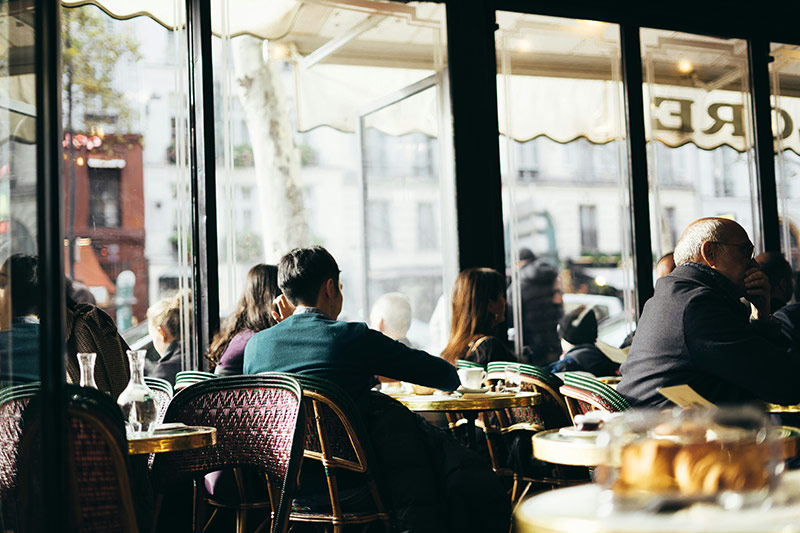
For writers and artists with limited money or workspace, a café could function as an office, reading room, meeting place, and informal salon. Customers wrote, exchanged manuscripts, debated politics, planned magazines, and watched the city pass outside the windows.
Guillaume Apollinaire, André Breton, Louis Aragon, Pablo Picasso, and many other figures became associated with Saint-Germain’s cafés. After World War II, however, two names came to define the neighborhood internationally: Jean-Paul Sartre and Simone de Beauvoir.
Sartre and Beauvoir worked in cafés, met friends and collaborators there, and participated in the political and philosophical debates of postwar France. Existentialism addressed questions that felt urgent after occupation, war, and genocide: What does it mean to be free? What responsibilities accompany that freedom? How do individuals create meaning in a world without predetermined answers?
Saint-Germain-des-Prés became the visible setting for these debates. International journalists turned the neighborhood into shorthand for a new kind of intellectual Paris. The image of black-clad existentialists discussing philosophy in smoke-filled cafés eventually became a cliché, but it grew from a genuine concentration of writers, editors, students, performers, and political thinkers.
The cafés remain, although their atmosphere and clientele have changed. They are now celebrated landmarks as well as working restaurants. Understanding their history allows visitors to see beyond their polished terraces and recognize the ideas, relationships, and controversies that once unfolded there.
The relationship between Saint-Germain-des-Prés and the United States extends far beyond the Lost Generation. After World War II, Paris became an important destination for African American writers, artists, and musicians seeking opportunities and freedoms that remained severely restricted by racial segregation at home.
Richard Wright, author of Native Son and Black Boy, moved to Paris with his family in 1946. He entered the city’s intellectual world, engaged with French writers and philosophers, and became a significant figure in the community of Black American expatriates.
James Baldwin arrived in Paris in 1948 at the age of twenty-four. He came with very little money but with an urgent need to gain distance from the racial pressures of the United States and to establish his own voice outside the influence of Wright, who had helped him early in his career.
Paris did not eliminate prejudice or hardship, and Baldwin’s experience should not be romanticized as effortless liberation. He endured poverty, uncertainty, and even imprisonment after a misunderstanding involving stolen hotel property. Yet his distance from the United States gave him a new perspective from which to examine race, identity, sexuality, belonging, and American society.
During his years connected with Paris, Baldwin completed his first novel, Go Tell It on the Mountain, and developed essays later collected in Notes of a Native Son. Saint-Germain-des-Prés and the wider Left Bank became part of the geography in which Black American writers met one another, encountered African and Caribbean intellectuals, and participated in conversations that crossed national boundaries.
For American visitors, this history provides a particularly powerful way to approach Saint-Germain. The neighborhood was not only a French intellectual enclave. It also became a space in which American writers could look back at their own country from abroad and redefine what it meant to be an American artist.
Jazz forms another essential connection between Saint-Germain-des-Prés and the United States. After the Liberation of Paris, underground clubs and cellar venues became gathering places for musicians, writers, actors, students, and young Parisians eager to leave the restrictions of wartime behind.
American jazz had already attracted devoted audiences in France before the war, but in postwar Saint-Germain it became the soundtrack of cultural renewal. Bebop, traditional jazz, improvised sessions, poetry, cabaret, and political discussion occupied overlapping worlds.
French figures such as Boris Vian and Juliette Gréco became associated with the neighborhood’s nightlife, while American musicians were received with an enthusiasm and respect that many had not always experienced at home.
Miles Davis first traveled to Paris in 1949 to perform at an international jazz festival. His experience in France had a profound impact on him. In Paris, he was celebrated as a major artist and moved within a cultural environment where musicians, writers, actors, and philosophers frequently crossed paths.
His relationship with Juliette Gréco became one of the most remembered personal stories linking American jazz to postwar Saint-Germain. More broadly, his time in Paris exposed the painful contrast between the recognition he received in France and the racism he continued to face in the United States.
Not every legendary jazz story associated with Saint-Germain can be attached to one surviving address, and many historic clubs have disappeared or changed. The importance of the period lies in the cultural exchange itself: American music transformed Parisian nightlife, while Paris offered American artists a different vision of their place in society.
Literature and jazz are only two parts of Saint-Germain’s identity. The neighborhood also belongs to the artistic geography of Paris. The nearby École des Beaux-Arts attracted generations of students and teachers, while the rue de Seine and surrounding streets developed a dense concentration of galleries and art dealers.
One of the neighborhood’s most atmospheric settings is Place de Fürstenberg, a small, intimate square hidden behind the busier streets. Here, the Musée National Eugène-Delacroix occupies the artist’s final apartment and studio.
Delacroix moved there in late 1857 to be closer to the Church of Saint-Sulpice, where he was working on the decoration of the Chapel of the Holy Angels. He lived and worked in the apartment until his death in 1863. The museum’s garden and studio preserve a sense of the private environment in which one of France’s greatest Romantic painters spent his final years.
The galleries of Saint-Germain later played an important role in presenting modern and contemporary art. Although changing real estate and commercial pressures have altered the neighborhood, art remains visible in its shop windows, exhibition spaces, museums, and architectural details.
Saint-Germain-des-Prés was once a royal burial place. Merovingian rulers were buried at the abbey before Saint-Denis became the principal necropolis of the French monarchy.
The church is only a surviving fragment of the former abbey. The medieval and early modern complex included chapels, cloisters, residences, gardens, and a renowned library.
Literary Saint-Germain was international long before modern tourism. French publishers and writers shared the neighborhood with American, Irish, British, African, and Caribbean authors who used Paris as a place of encounter and reinvention.
The historic Shakespeare and Company was not the bookstore opposite Notre-Dame. Sylvia Beach’s original shop stood on the rue de l’Odéon. The present bookstore was founded later by George Whitman and adopted the Shakespeare and Company name in the 1960s.
Modern Saint-Germain-des-Prés is not the inexpensive bohemian neighborhood remembered in postwar memoirs. Rising property values, international tourism, fashion boutiques, and luxury brands have transformed its streets. Some historic bookstores and clubs have vanished, while famous cafés have become destinations in their own right.
It is easy to mourn the neighborhood as a lost world. Yet Saint-Germain has never belonged to a single frozen moment. The medieval abbey, nineteenth-century artists, Lost Generation, existentialist cafés, jazz cellars, and contemporary galleries each represent a different reinvention.
Books are still published here. Exhibitions still open. Students, residents, travelers, collectors, readers, and musicians continue to share its streets. The neighborhood’s creative life may no longer resemble the photographs of the 1940s and 1950s, but its past remains unusually present.
This presentation approaches Saint-Germain-des-Prés as a place rather than prescribing a fixed walking route. Its history can be explored through several complementary perspectives, depending on your interests and the time available.
One experience might emphasize the medieval abbey and the development of the Left Bank. Another might focus on Sylvia Beach, Hemingway, Baldwin, Wright, and the neighborhood’s international literary networks. Art enthusiasts may prefer Delacroix and the gallery district, while music lovers can examine the relationship between American jazz and postwar Paris.
Historic café interiors, the Church of Saint-Germain-des-Prés, the Delacroix Museum, and other cultural sites may be incorporated when opening hours, access conditions, and the desired format allow. A private experience can be created for an individual traveler, a couple, a family, friends, an association, or a larger group.
Make Saint-Germain part of your Paris story
Tell us what inspires you—literature, African American history, jazz, art, medieval Paris, or the timeless atmosphere of the Left Bank—and we will shape the experience around you.
Saint-Germain-des-Prés rewards visitors who know how to look beyond its most photographed terraces. Many of its defining stories are hidden behind altered façades, discreet plaques, vanished clubs, former bookstores, private courtyards, and buildings that have changed purpose many times.
A professional guide can connect the surviving medieval church with the lost abbey, explain how publishing shaped the neighborhood, and distinguish documented history from romantic legend. The experience also reveals the connections between French intellectual life and the American writers and musicians who found inspiration, recognition, or a new perspective in Paris.
Rather than simply checking famous names off a list, you begin to understand why this small area of the Left Bank became such a powerful cultural symbol—and why it continues to matter to travelers from the United States today.
Saint-Germain-des-Prés and the surrounding Left Bank played important roles in the lives of several generations of American writers and musicians. Ernest Hemingway belonged to the expatriate literary community centered partly around Sylvia Beach’s original Shakespeare and Company, while Richard Wright and James Baldwin found new intellectual perspectives in postwar Paris. American jazz musicians, including Miles Davis, were also welcomed by enthusiastic French audiences. These connections make the neighborhood an important chapter in both French and American cultural history.
No. This page introduces Saint-Germain-des-Prés as a historic and cultural place. Your experience can emphasize the former abbey, American writers in Paris, existentialism, jazz, art galleries, publishing, or a combination of themes. The exact content and places included can be adapted to your interests.
Yes. The experience can be designed for solo travelers, couples, families, friends, associations, or larger groups. Its duration, pace, historical focus, and possible interior visits can be adjusted to the people taking part.
Located on the historic Île de la Cité in the heart of Paris, Sainte-Chapelle is one of the most breathtaking monuments in…
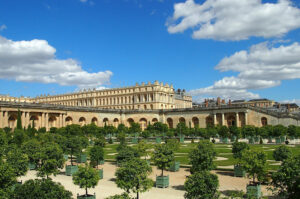
Versailles is where architecture, ritual, and landscape fused into a single theater of power—and where world history repeatedly returned to the same…
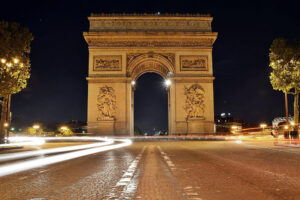
The Arc de Triomphe is much more than one of France's most famous monuments. Standing proudly at the western end of the…
Would you like to plan a similar experience? Request your personalized itinerary.