Visit the Grottes du Foulon and Château de Maintenon
This escapade offers groups a richly contrasting day, combining geological discovery and historical heritage. Between a visit to the Grottes du Foulon…
Fill up on discoveries
We organize your transport by coach, train or plane
Passez de surprise en surprise au fil de votre journée
Go alone or in a group to discover these places
You won't miss a single detail - they know their subject inside out.
In the quiet countryside of Eure‑et‑Loir, a single day brings together two very different vantage points on French history. At Thiron‑Gardais, an early‑12th‑century abbey complex later gave rise to a 17th‑century college that Louis XVI elevated in 1776 to the rank of a royal and military college—an episode linked to reforms associated with the comte de Saint‑Germain. Today, the former classes house an intimate museum beside restored historic gardens that frame the Romanesque abbatial church. Not far away, the medieval town of Bonneval spreads along canals and the Loir, earning the nickname “Petite Venise de la Beauce.” Piloting a small electric boat, you drift past old washhouses and fortified gates for a close, water‑level read of its past.
Some places tell their story in layers, and Thiron‑Gardais is one of them. The abbey that took root here in the early 1100s participated in the Tironensian current, a movement whose influence reached across France and into the British Isles. Centuries later, amid shifting ideas about education and service to the state, a college rose beside the church. When Louis XVI made it one of the kingdom’s royal and military colleges in 1776—within a reforming spirit associated with the comte de Saint‑Germain—the site became connected to a national conversation about how to form young elites.
Today, inside the former classrooms, the Collège Royal et Militaire de Thiron‑Gardais presents a human‑scale museum that reads like a set of footnotes brought to life: portraits, a school uniform, a reconstructed classroom, and period objects that reconnect names and dates to the texture of study and rank. Step back outside and the story shifts from wood and paper to living greenery. The historic gardens, reworked with the expertise of landscape designer Louis Benech, are a measured, thoughtful landscape where a labyrinth and a remarkably old greenhouse sit within view of the Romanesque abbatial church.
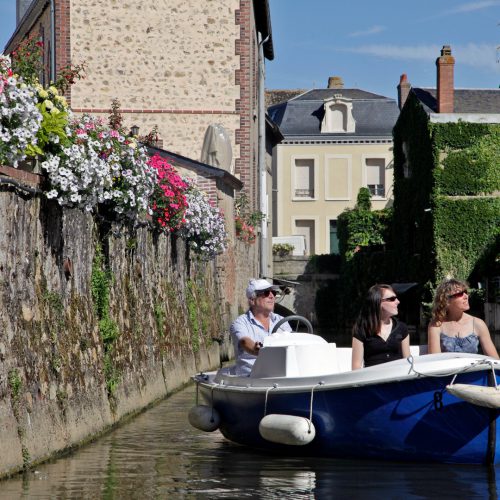
To balance the day, you approach history again—but from the water. In Bonneval, canals braid through a fortified town once organized for defense and trade. A small electric boat, piloted by visitors without a license, offers a calm drift along the Loir and through still canals. The town’s nickname, the “Little Venice of Beauce,” is less a claim to grandeur than a faithful description of a footprint shaped by waterways. Rounded towers, gateways, bridges, and stone façades appear at the speed of the current, and even a simple sighting of ducks adds to the sense of time slowed down.
The story begins in the early 12th century, with an abbey associated with Saint Bernard de Tiron (Bernard of Abbeville). The Tironensian movement formed a network of priories and daughter houses, extending influence far beyond this quiet corner of today’s Centre‑Val de Loire. That ecclesiastical foundation provided the setting for an educational project that would come much later.
In 1630, Henri de Bourbon‑Verneuil, a natural son of Henri IV, founded a college at Thiron‑Gardais to educate local nobility under Benedictine Maurist oversight. The college’s mission, rooted in discipline and learning, echoed European debates about how to shape character, belief, and capacity for service. Almost a century and a half later, as the crown considered the future composition of its officer corps and administrators, the establishment took on a more explicitly national role.
In 1776, under Louis XVI—with a reforming agenda associated with the comte de Saint‑Germain—Thiron‑Gardais became one of the kingdom’s royal and military colleges. That change formally tied the institution to the monarchy’s framework for training, placing it among a select group designed to prepare future officers and leaders. An intriguing footnote: a bursary dated December 31, 1778 named Napoleon Bonaparte for the Tiron college, though his father ultimately obtained admission for him at Brienne instead. The Tiron admission process required proofs of nobility, a detail that reflects how social classification and education interlocked at the time.
The college closed in 1793, caught in the sweeping transformations of the Revolution. What followed was a long period in which the site’s purpose dimmed, as sometimes happens with institutions overtaken by change. Its modern revival is the work of committed stewardship: Stéphane Bern acquired the property in 2012/2013 and opened it to the public with a museum in 2016, following significant restorations. That decision re‑established Thiron‑Gardais as a place where history can be read in situ, rather than in footnotes alone.
The museum is set within the former classes of the college, a context that lends special resonance to what you see. On the walls, portraits connect names to faces—among them Louis XVI and the comte de Saint‑Germain, each a reference point for the college’s royal and military chapter after 1776. These images remind visitors that institutions are built by decisions made elsewhere, but their consequences are felt locally, in rooms much like the one you are in.
A reconstructed classroom gathers the cues of study into a single space, while a student uniform speaks to rank, belonging, and the rituals that once governed daily life here. Objects tied to the abbey and the colleges act as small anchors to larger currents—teaching methods, spiritual oversight, and the practical realities of running an establishment intended for the nobility. Because the museum lives within the former classes, it is easier to imagine how ideas moved through these spaces, and how the evolution from a regional college to a royal and military institution changed expectations.
Step outdoors and the register changes from documents to living form. The historic gardens adjoining the Romanesque abbatial church have been reworked under the guidance of landscape designer Louis Benech. The result is not a pastiche, but a poised landscape that balances old specimens and new plantings with a gentle sense of order. Paths invite a measured pace, and features such as a labyrinth make the walk as much about reflection as movement.
One feature holds particular interest for heritage‑minded travelers: a historic greenhouse, counted among the oldest in the region. Its presence in the gardens adds a layer of technical and botanical history to what might otherwise be a purely aesthetic encounter. When seen together—the church’s masonry, the thoughtful garden design, and the echo of classrooms nearby—the site forms a compact but deeply textured ensemble.
Ready to pair Thiron‑Gardais’ museum and historic gardens with a tranquil electric‑boat discovery of Bonneval? Speak with Suite Voyage Discovery about tailoring this day to your broader journey in Centre‑Val de Loire.
Arriving in Bonneval, the logic of the place becomes legible from the canals. The town’s municipal Capitainerie operates small electric boats that visitors pilot themselves without a license. The boats move quietly along narrow canals and on the Loir, letting you match pace with a town designed for water. The nickname “Petite Venise de la Beauce” is more than charm: waterways truly thread the urban fabric.
From this low vantage point, medieval features reveal themselves in sequence. You glide past lavoirs—old washhouses set at the water’s edge—then approach the Porte Saint‑Roch, a 15th‑century gate that once framed passage between in and out. The Tour du Roi, dating to the 13th century, hints at the town’s fortified past. As you progress, the Gothic Église Notre‑Dame anchors the skyline, while the former Abbaye Saint‑Florentin, founded in 857 and today part of a hospital site, presents stately exteriors from the water. The scene is enlivened by simple notes of nature—ducks are a common sight—without disturbing the sense of calm.
The self‑piloted format keeps the experience immediate and personal. With no engine noise to speak of and no license required, it is an accessible way to understand how waterways set the rhythm of a place. The outing is often particularly appreciated by children, who respond to the novelty of steering a small craft through a town where bridges and towers seem scaled for stories.
Seen together, Thiron‑Gardais and Bonneval offer a complementary study in time and perspective. In the morning you might be absorbed in documents and portraits, thinking through how an abbey landscape nurtured a college that would, in 1776, become part of the monarchy’s framework for shaping officers. Later, on the water, the same centuries come into view differently, expressed in towers, gates, and bridges built to manage and benefit from the Loir’s currents. One part of the day reads history in rooms and gardens; the other follows the lines that connect people and water across the town’s plan.
Because both sites operate seasonally, the excursion naturally adapts to different times of year. The museum’s intimate scale and the gardens’ thoughtful layout welcome unhurried exploration, while the electric‑boat outing supplies a counterpoint of movement and open sky. The combination has a way of keeping even a compact day mentally expansive: documents, landscapes, and stonework are in conversation with each other, and with you.
This one‑day excursion combines a guided visit at the Collège Royal et Militaire de Thiron‑Gardais—including the museum installed in the former classes and the historic gardens—with an electric‑boat ride through Bonneval. In the museum, you encounter portraits (among them Louis XVI and the comte de Saint‑Germain), a reconstructed classroom, a student uniform, and objects linked to the abbey and colleges. Outside, you trace the landscaped walk through gardens that mix historic specimens and new plantings, including a labyrinth and a historic greenhouse counted among the oldest in the region.
In Bonneval, you set out on a self‑piloted electric boat along canals and the Loir, an outing known for its calm, family‑friendly rhythm. From the water you’ll take in lavoirs, the 15th‑century Porte Saint‑Roch, the 13th‑century Tour du Roi, the Gothic Église Notre‑Dame, and exteriors of the former Abbaye Saint‑Florentin. Along the way, ducks often dot the scene, adding a gentle, natural counterpoint to the town’s stonework.
Part of the pleasure here is how the day refuses to rush. The museum at Thiron‑Gardais is deliberately intimate; it does not attempt to compress national history into a vast survey. Instead it shows how one institution, at one place, passed through distinct identities—from abbey setting to college to royal and military college, then through closure and revival. The gardens offer space to let those stages settle in your mind, with the abbatial church as a steady landmark.
The electric‑boat element restores a different kind of proportion. Instead of “covering” the town, you follow it, learning its structure at a measured speed. Fortifications and ecclesiastical sites appear and recede in a logical order, set by waterways that once defined routes and livelihoods. It is a way to learn that favors attention over accumulation.
Both parts of this experience follow the operating rhythms of their respective sites. The Royal and Military College’s museum and gardens operate seasonally, and the Capitainerie in Bonneval publishes seasonal schedules for its self‑piloted electric boats, with days and hours that vary by month and weather. Those calendars are not a fixed visitor timetable for this program; they are simply how each place works. Within those rhythms, Suite Voyage Discovery composes a day that pairs the guided heritage visit at Thiron‑Gardais with the on‑the‑water discovery of Bonneval in a way that feels coherent and unhurried.
This day sets a tone for exploring Eure‑et‑Loir and the wider Centre‑Val de Loire. If you respond to layered places—where medieval foundations meet later transformations, and where towns are best understood from gardens or from the water—you will find that this region offers many ways to keep developing those themes. Suite Voyage Discovery can integrate this Thiron‑Gardais and Bonneval pairing into a broader itinerary that balances heritage, landscape, and time to simply look.
Weave Thiron‑Gardais’ museum and historic gardens together with Bonneval’s quiet canals on a day designed for how you like to travel.
This program is built around two components documented here: a guided visit of the Collège Royal et Militaire de Thiron‑Gardais (museum and historic gardens) and an electric‑boat ride in Bonneval. It reflects the sites’ established features and present‑day offer, including the self‑piloted nature of the boats (no license required). Schedules for both places are set by their own operators and may vary by season and weather.
Rooted in an early‑12th‑century abbey landscape associated with the Tironensian movement, the Thiron‑Gardais college was founded in 1630 by Henri de Bourbon‑Verneuil to educate local nobility under Benedictine Maurist oversight. In 1776, under Louis XVI—with reforms associated with the comte de Saint‑Germain—it became one of the kingdom’s royal and military colleges. After closing in 1793, the site experienced a long decline before its revival: Stéphane Bern acquired it in 2012/2013 and opened it to the public with a museum in 2016. Today, visitors encounter an intimate museum within the former classes and historic gardens adjoining the Romanesque abbatial church.
The museum presents focused displays connected to the college’s story: portraits (including Louis XVI and the comte de Saint‑Germain), a reconstructed classroom, a student uniform, and objects tied to the abbey and colleges. Outside, the restored historic gardens—reworked by landscape designer Louis Benech—offer a landscaped walk that blends old specimens with new plantings. Features include a labyrinth and a historic greenhouse counted among the oldest in the region, all within view of the abbatial church.
Bonneval’s waterways and canals shape a fortified medieval townscape, hence the nickname “Little Venice of Beauce.” The municipal Capitainerie operates small electric boats that visitors pilot themselves without a license, along canals and the river Loir. From this water‑level perspective, you can take in lavoirs (washhouses), the 15th‑century Porte Saint‑Roch, the 13th‑century Tour du Roi, the Gothic Église Notre‑Dame, and exteriors of the former Abbaye Saint‑Florentin. The ride is calm and family‑friendly, with common wildlife sightings such as ducks.
This escapade offers groups a richly contrasting day, combining geological discovery and historical heritage. Between a visit to the Grottes du Foulon…
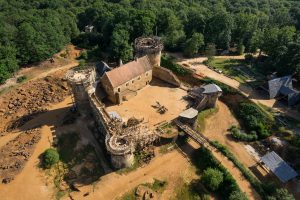
Visit Guédelon castle, a medieval construction site unique in France In the heart of Burgundy, the fortified castle of Guédelon is a…
Maréis, Étaples-sur-Mer and Le Touquet-Paris-Plage: an immersion between fishing, heritage and seaside elegance This escapade offers groups a complete discovery of the…
Would you like to plan a similar experience? Request your personalized itinerary.