
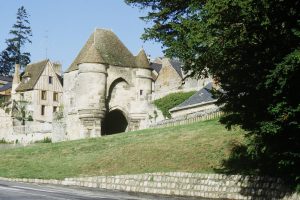
The underground passages and medieval city of Laon
Fascinating immersion in underground mysteries and historical heritage Perched on its famous hill, Laon, nicknamed the "crowned mountain", offers a unique experience…
Fill up on discoveries
We organize your transport by coach, train or plane
Châteaux, grottes, parcs, jardins, villages, monuments historiques...
Go alone or in a group to discover these places
You won't miss a single detail - they know their subject inside out.
UNESCO recognizes Bourges Cathedral as a masterpiece of Gothic architecture, and the reasons become clear the moment you step before its five sculpted portals. Here, in the medieval city once known as Avaricum, a singular church without a transept unfolds in one unbroken sweep of space—vast, luminous, and ringed with stained glass that spans the 13th to 17th centuries. Just a short stroll away, the flamboyant Gothic silhouette of the Palais Jacques Cœur tells a different story of the Middle Ages: commercial power, royal finance, and a visionary patron who reshaped how a great urban residence could function.
This guided cultural visit brings these two monuments into conversation. One voices the spiritual authority of medieval Bourges; the other, the confidence and reach of a merchant-banker at the court of Charles VII. Between them, you gain a clear reading of the city’s religious and economic heart—and of Gothic art’s extraordinary range, from soaring nave to sculpted stone household.
Few places illustrate the breadth of Gothic imagination as convincingly as Bourges. In the cathedral, the decision to forgo a transept yields an interior of unusual coherence: aisles stepping up like nested shells, light advancing through layered arcades, and glass telling centuries of stories. In the palace, the Gothic idiom moves from liturgy to daily life—crafted façades, intricate stair turrets, and a plan that isolates public functions from private retreat. Seeing them together clarifies how late medieval France expressed sacred purpose and worldly ambition in stone.
Bourges Cathedral is also the mother church of the local diocese, set within a protected historic urban fabric. Its UNESCO inscription highlights Outstanding Universal Value under criteria (i) and (iv), recognizing both artistic mastery and a pivotal place in the development of Gothic architecture. Meanwhile, the Palais Jacques Cœur represents a different kind of masterpiece: an innovative residence erected between 1443 and 1451 by a merchant-turned-royal treasurer at the height of his influence. The juxtaposition is illuminating—and deeply memorable.
Work on the Cathedral of Saint-Étienne advanced from the end of the 12th century, with building underway by 1195. The plan’s most striking feature is its absence of a transept, unusual among the great Gothic churches of France. The effect is immediate and architectural: rather than crossing arms interrupting the nave, a continuous volume draws a visitor forward beneath rising tiers of arcades and clerestories. The drama comes not from intersection, but from progression.
Outside, the west façade presents five carved portals, an expansive stone threshold whose sculpted program frames entry into the sacred interior. The two towers give the façade an asymmetrical history: the north tower collapsed in 1506 and was rebuilt beginning in 1508; the south tower is traditionally called the “deaf” tower because it lacks bells. This mixture of unity and variability—an interior of rare coherence paired with a façade that records centuries of adjustments—tells the long story of a living monument.
Within, Bourges is renowned for light. Stained glass from the 13th to the 17th centuries rings the building with color and narrative, a sustained artistic ensemble that rewards close looking. The architecture seems designed to amplify that luminosity: multiple aisles, tiered elevations, and stonework calibrated to lead the gaze upward. UNESCO’s evaluation underscores this orchestration of space and light as a defining contribution to Gothic art.
The cathedral’s stained glass is more than decoration; it is a chronological panorama. Panels from the earliest Gothic decades stand alongside later additions and restorations, offering an unusually broad spectrum of styles and techniques. The result is a rare opportunity to understand how glassmakers and patrons revisited themes and revived methods across four centuries, all within a single, coherent sanctum.
The north tower’s history—its collapse in 1506 and subsequent rebuilding—reminds visitors that great churches are never finished in a single moment. The possibility of climbing the tower today (396 steps) offers, when conditions allow, a powerful change of scale: the sculpted details of the façade become part of a larger urban geometry, with the medieval city radiating below. While access depends on the monument’s own operations, the ascent, when available, sharpens your sense of where the cathedral sits in relation to streets, rooftops, and gardens that have grown around it for centuries.
This is a guided cultural visit centered on two major monuments: Bourges Cathedral and the Palais Jacques Cœur. With your guide, you’ll focus on what makes each site significant, from the cathedral’s unified plan and exceptional stained glass to the palace’s flamboyant Gothic language and its forward-thinking organization of spaces. Together they allow a reading of medieval Bourges through two complementary powers: religious authority at the cathedral and economic–political influence at the palace.
Highlights include an appreciation of the cathedral’s vast nave, luminous interior, and rich sculpted décor. There is also a possibility to climb the cathedral tower for a panoramic view of the city—396 steps—when the monument’s conditions permit. Your visit continues at the Palais Jacques Cœur, where you take in a residence celebrated for its scale and refinement, historically described as encompassing 43 rooms and eight staircases, and for an organization that clearly distinguished public from private life—an innovation that would resonate long after its construction.
Ready to weave UNESCO-listed sacred architecture with a landmark of flamboyant Gothic living? Speak with Suite Voyage Discovery to shape a tailor-made Bourges visit around these two masterpieces and the wider character of central France.
Between 1443 and 1451, Jacques Cœur—a wealthy merchant who rose to become argentier (treasurer) to King Charles VII—commissioned a residence that would reshape expectations of a great urban palace. Its style is flamboyant Gothic, the late-medieval phase known for intricate tracery, energetic silhouettes, and an almost calligraphic treatment of stone. Yet it is not only the surface that astonishes. The palace was conceived with a forward-looking separation of functions, organizing public reception and private life with a clarity that feels strikingly modern in intent.
Contemporary descriptions and later documentation highlight the building’s scale—about forty-three rooms served by eight staircases across an expansive footprint. That complexity never dissolves into confusion: the palace is a masterclass in circulation, allowing movement between ceremonial and domestic spaces without structural compromise. Its sculpted decoration underscores the owner’s reach and the pride of a city enmeshed in trade and royal finance during a moment of renewed stability in 15th-century France.
The palace’s afterlife is part of its story. Over the centuries it served as city hall and housed various courts, ultimately functioning as the Palais de Justice in the 19th century. It was among the earliest buildings included on France’s first Historic Monuments list (1840), and by 1923 the French State had acquired the property, setting in motion restorations that made it accessible to the public. Today, it is managed and opened to visitors by the Centre des monuments nationaux (CMN), the same national body involved in the stewardship of the cathedral site.
Visiting the Palais Jacques Cœur after the cathedral sheds light on a different kind of Gothic mastery: how the language of pointed arches and stone ribs adapts to domesticity, status, and the rhythms of a household whose patron moved easily between the marketplaces of Bourges and the corridors of royal power.
When you place cathedral and palace side by side, a city’s structure comes into view. The cathedral anchors spiritual life and projects a vision of unity—of plan, light, and purpose—that resonated across the medieval world. The palace translates late Gothic artistry into civic life, where access, representation, and privacy must be negotiated across thresholds and staircases. Their proximity is not an accident of geography, but a dialogue: clergy and merchants, diocese and treasury, each shaping Bourges’s identity in enduring ways.
This reading extends beyond façades. The cathedral’s stained glass charts an evolving practice over four centuries, a testament to faith, resources, and craft workshops that remained active across generations. The palace’s organization of public and private space signals a change in how power was exercised and seen. Both works remind us that architecture is not just built—it is performed, through ceremonies, councils, receptions, and the daily pathways that residents and visitors trace.
Both sites benefit from national stewardship. Bourges Cathedral is State property and part of a network of historic monuments overseen in collaboration with the Centre des monuments nationaux. The Palais Jacques Cœur is similarly managed by CMN. For travelers, this translates into careful conservation and interpretation—an assurance that what you encounter reflects long-term commitments to preservation and public access.
The cathedral’s mother-church status within the Diocese of Bourges situates it at the summit of local ecclesiastical life, while the palace’s royal connections place it within broader currents of 15th-century French history. Together, these contexts add depth to every carved capital and window panel, reframing them not as isolated masterpieces but as actors in a complex urban and political stage.
UNESCO’s recognition of the cathedral is not merely a gold seal; it stems from specific qualities: the unity of its interior, the coherence of its plan, and the historical range of its glass. Standing beneath its vaults, you understand why the site rises beyond local importance. Visiting the palace, you see how Gothic language could carry courtly symbolism and practical innovation with equal confidence—an insight that broadens the very idea of what “Gothic” means.
Bring the cathedral’s great nave and the Palais Jacques Cœur’s elegant stonework into a journey paced to your interests. Suite Voyage Discovery can shape a bespoke Bourges program that balances sacred and civic heritage across a single, compelling day.
Bourges rewards unhurried exploration. The cathedral’s setting within a preserved medieval fabric invites reflection on how streets, courtyards, and gardens grew around its mass over centuries. The palace’s urban presence, meanwhile, hints at the networks of commerce and administration that once pulsed through the city. Whether you are traveling as a couple, with family, or with friends, combining these two visits anchors your understanding of central France at a meaningful human scale.
From here, it is easy to fold Bourges into a wider itinerary across France—linking sacred and civil architecture, craftsmanship and urban history—while keeping the experience personal. The city’s layered past and the artistry of its monuments linger long after you leave, reshaping how you see Gothic lines wherever you encounter them next.
Some cathedrals astonish with size; others with rarity. Bourges impresses with unity—of plan, light, and time—held in a single architectural gesture. The Palais Jacques Cœur complements that unity with ingenuity, showing how late Gothic style could craft a life of ceremony and retreat under one roof. Taken together, they form an essential chapter in France’s medieval story and a rewarding focus for any cultural traveler.
When you step back at day’s end—perhaps after a tower ascent that framed the city like a living map—you carry a double image: a sacred vessel of glass and stone, and a civic jewel whose staircases once shaped the flow of power. It is a pairing that stays with you.
Bourges Cathedral stands out for its plan with no transept, creating an exceptional unity of interior space. Its west façade displays five carved portals, and the building preserves a major ensemble of stained glass spanning the 13th to the 17th centuries. Recognized by UNESCO in 1992 (criteria i and iv), it represents both artistic excellence and a key stage in the development of Gothic architecture.
Jacques Cœur was a wealthy merchant who became argentier (treasurer) to King Charles VII. Between 1443 and 1451 he built the Palais Jacques Cœur in Bourges, a masterpiece of flamboyant Gothic civil architecture. Historically noted for 43 rooms and 8 staircases, the palace innovatively separated public reception areas from private quarters, reflecting the ambitions and organizational sophistication of its patron.
There is a possibility to climb the cathedral’s north tower, which involves 396 steps and leads to panoramic views when access is available. Tower access depends on the monument’s own operations and conditions and is not guaranteed for every visit.
Fascinating immersion in underground mysteries and historical heritage Perched on its famous hill, Laon, nicknamed the "crowned mountain", offers a unique experience…
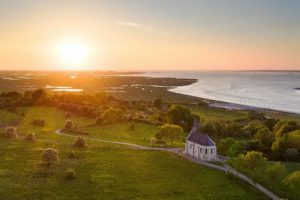
A day in the Baie de Somme, between wilderness, seals and exceptional landscapes Just two hours from Paris, the Baie de Somme…
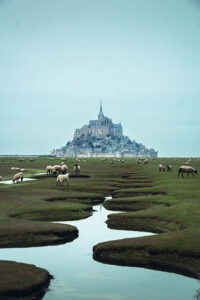
Few places in the world inspire as much wonder as Mont Saint-Michel. Rising dramatically from the waters of a vast tidal bay…
Would you like to plan a similar experience? Request your personalized itinerary.