
Seinoscope & Biotropica: River Science and Wildlife at Léry‑Poses, Normandy
On the Seine at Poses, Normandy’s Seinoscope offers the only public underwater viewing chamber on the river — a rare chance to…
Fill up on discoveries
We organize your transport by coach, train or plane
Musées, Châteaux, grottes, parcs, jardins, villages, monuments historiques... Découvrez les plus beaux sites à visiter en France
Go alone or in a group to discover these places
You won't miss a single detail - they know their subject inside out.
Two UNESCO World Heritage sites, one meaningful arc of history: this day unfolds Burgundy’s spiritual and architectural genius from the austere beauty of the Cistercian Abbey of Fontenay to the luminous heights of the Basilica of Sainte‑Marie‑Madeleine in Vézelay. At Fontenay, early 12th‑century ideals take material form in stone, light, and silence; at Vézelay, a masterpiece of Burgundian Romanesque art carries the memory of great pilgrimages and epoch‑defining sermons. Seen together, they reveal how faith, craftsmanship, and landscape shaped a region—and, for a time, Europe’s imagination.
In Burgundy, spiritual ambition took contrasting paths that remain legible in stone. Fontenay Abbey, founded in the early 1100s and attributed to Bernard of Clairvaux, crystallizes Cistercian principles: purposeful simplicity, harmonious proportions, and light used with restraint. Vézelay’s basilica, by contrast, gathers pilgrims beneath a radiant Romanesque nave whose sculpted program—most famously the narthex tympanum with Christ in Glory—communicates a universal mission. One site quiets the eye; the other opens it wide. Together, they chart a cultural movement across the 12th and early 13th centuries, a moment when monastic reform, sacred art, and the currents of pilgrimage intersected.
UNESCO recognizes the Cistercian Abbey of Fontenay (inscribed in 1981, criterion iv) as an exceptional testimony to Cistercian monastic architecture. The abbey’s foundation is attributed to Bernard of Clairvaux, with principal sources placing it in 1118 (official abbey site) or 1119 (UNESCO). This small difference in dates does not alter what the place conveys: a clear, coherent expression of early 12th‑century reform ideals translated into architecture.
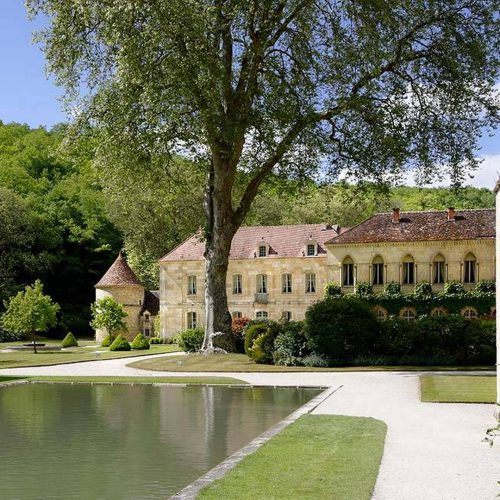
What makes Fontenay remarkable is not only its age but its state of preservation. The site conserves the abbey church, cloister, chapter house, and monks’ dormitory—the beating heart of community life—as well as a remarkably early piece of industrial heritage: a late‑12th‑century ironworks with hydraulic installations, counted among the oldest industrial buildings in France. Other monastic service buildings historically associated with such sites (for example, refectory, bakery, or guesthouse) are documented at Fontenay, yet what resonates most strongly for today’s visitor is the core ensemble where prayer, governance, rest, and work were thoughtfully organized in space.
All of this sits in a natural setting whose landscaped gardens amplify the monastery’s contemplative mood. Fontenay’s location in Marmagne (Côte‑d’Or) anchors it in a quiet Burgundian valley, long protected—listed as a Historic Monument since 1862 and today a private property open to the public and safeguarded within a buffer zone. The result is rare continuity: a place where proportion and material speak more loudly than ornament, and where the Cistercian pursuit of essential forms feels surprisingly contemporary.
Cistercian architecture deliberately avoids excess. At Fontenay, Romanesque forms are kept pure: rounded arches, measured bays, unforced light. The cloister acts as both a contemplative heart and a pragmatic circulatory system, connecting daily functions with elegant clarity. The chapter house embodies the order’s administrative and spiritual rhythm; the monks’ dormitory communicates communal life through its long, restrained volume. The ironworks and its hydraulic features testify to monastic ingenuity—a reminder that contemplation and skilled labor were never opposites in this tradition.
Across Burgundy rises the celebrated hill of Vézelay, whose church and hill were inscribed on the World Heritage List in 1979 (criteria i & vi). Vézelay’s history is inseparable from pilgrimage: soon after its 9th‑century foundation, the abbey acquired relics of St Mary Magdalene and became a major destination for pilgrims. Events of European scale followed. Bernard of Clairvaux preached the Second Crusade here in 1146; Richard the Lionheart and Philip II met on this hill before departing on the Third Crusade in 1190. The place retains the gravity of those moments while remaining very much alive today.
Architecturally, the Basilica of Sainte‑Marie‑Madeleine is a masterpiece of Burgundian Romanesque art. The central nave, commonly dated to around 1120–1140, channels light in a way that seems to animate the stone. At the threshold between nave and narthex stands the celebrated tympanum of the ‘Mission of the Apostles’, with Christ in Glory sending the apostles into the world—a sculpted vision of energy and purpose. Later, the choir and transept evolved in a Gothic direction, likely in the early 13th century, sharpening the contrast between the Romanesque body and the pointed forms of renewal toward the east. For travelers attentive to detail, this visible dialogue of styles makes Vézelay an education in stone.
The basilica remains an active place of worship. Regular liturgical offices are published on its official site, and access to some areas can be affected when services are underway. For cultural travelers, that living dimension adds resonance: the same space that once heard Bernard’s preaching still hosts prayer today.
This cultural day is built around immersive guided visits in two complementary settings. At Fontenay Abbey, your guided exploration focuses on the Romanesque abbey church, cloister, chapter house, and monks’ dormitory, then turns to the 12th‑century ironworks and its hydraulic installations—a rare encounter with early monastic industry. The surroundings, with gardens and landscaped spaces, invite a reflective pause that fits the Cistercian spirit of the place.
At Vézelay, you arrive at an ‘eternal hill’ whose village fabric has preserved a palpable medieval character. The setting opens to panoramic views across the countryside before drawing you to the basilica itself, where guided interpretation highlights the sculpted narthex tympanum, the luminous nave, and the choir where a Gothic language emerges from Romanesque roots. Considered together, these elements transform the visit from a sequence of monuments into a story about ideals, craft, and time.
Design a tailor‑made Burgundy day around Fontenay and Vézelay. Start a conversation with Suite Voyage Discovery: request your custom quote.
Travelers often sense that Fontenay and Vézelay belong together, but the reasons become clearer with a thoughtful reading of their forms and histories.
Cistercian restraint at Fontenay is not minimalism for its own sake; rather, it channels attention to essentials. The abbey church’s measured bays and quiet surfaces teach the eye to appreciate proportion and light without distraction. Moving through the cloister, chapter house, and dormitory, you trace how the order sustained community life with structural clarity. Then the ironworks—powered through hydraulic installations—reminds you that monastic work was both practical and technically savvy. UNESCO’s recognition under criterion (iv) underscores the site’s value as an exceptional example of an architectural ensemble illustrating a significant stage in human history.
Vézelay, by contrast, takes the communicative power of architecture and sculpture to its zenith. The nave (c. 1120–1140) orchestrates light in a way that gives rhythm to the space; the narthex tympanum projects a theological idea—the sending of the apostles—through bold imagery; and the Gothic choir and transept mark an openness to renewal in the early 13th century. UNESCO’s criterion (i) highlights the basilica’s status as a masterpiece of human creative genius, while criterion (vi) points to its direct association with major events and traditions, from the relics of St Mary Magdalene to the Second and Third Crusades.
Seen in sequence, Fontenay and Vézelay function like a dialogue. One pursues purity; the other proclaims mission. One privileges enclosure, the other invites the world. Yet both draw strength from Burgundian stone and a disciplined sense of order. A day between them reveals not opposition but complementarity: contemplation giving energy to action, and action returning to contemplation for meaning.
Both sites belong to landscapes that shape the experience. At Fontenay, the gardens and landscaped spaces slow your pace, encourage attentive looking, and make the abbey feel like a complete work. At Vézelay, the hilltop village frames the basilica with streets and stonework that still read as medieval, and the panoramic views open the visit beyond architecture to a larger geography—one that pilgrims once crossed in numbers.
Few works condense Romanesque ambition like the narthex tympanum at Vézelay, often called the Mission of the Apostles. At the center stands Christ in Glory, radiating dynamism as the apostles fan outward. Whether you read it as sacred narrative or sculpted exhortation, the message is clear: what begins here must go out into the world. That idea resonated with the basilica’s role in pilgrimage, and with the historical sermons that once stirred vast movements from this hill.
Inside, the luminous nave makes light itself into an interpretive tool. While the technical specifics of how that effect is achieved belong to scholars, travelers consistently notice how the nave’s design organizes space and brightness into a legible rhythm—one that prepares the transition to the Gothic choir and transept, where pointed forms and an evolved sensibility appear.
Cistercian aesthetics at Fontenay prioritize clarity. The cloister is not only beautiful but also practical, threading together life and work within a serene quadrangle. The chapter house organizes governance and reflection; the monks’ dormitory communicates community through its shared volume rather than ornament. Even the ironworks participates in the order’s values: labor dignified by purpose and intelligence, here evidenced by hydraulic installations that once animated industry at the monastery’s edge. UNESCO’s evaluation emphasizes this coherent ensemble as a high‑order example of its type.
Vézelay’s official UNESCO designation embraces not just the basilica but the church and hill, recognizing a broader cultural landscape. The village’s preserved medieval fabric sets a tone before you reach the sanctuary, while the panoramic views place the experience in a far horizon. For many travelers, this combination of close‑up texture and long view captures the essence of Burgundy’s layered past.
Because both sites are UNESCO World Heritage properties and widely appreciated, it is sensible to approach the day with intention. The basilica at Vézelay is an active place of worship, and access to some areas can be affected when services are taking place. Beyond that, the heart of the day lies in embracing two complementary readings of sacred space—one marked by Cistercian sobriety, the other by Romanesque proclamation and a later Gothic inflection.
Burgundy rewards curiosity. After a day that balances the introspective calm of Fontenay with the expansive energy of Vézelay, many travelers find themselves wanting to continue exploring the region’s conversations between stone, landscape, and memory. Whether you prefer hilltop vistas, monastic traces, or the rhythms of Burgundian towns and countryside, the themes opened here can unfold across a thoughtful itinerary crafted to your interests.
Fontenay and Vézelay are not simply beautiful monuments; they are two lenses on how a culture shaped its spiritual life and built environment. One refines experience to essentials; the other gathers the world into an image and sends it back outward. On this day in Burgundy, the past becomes articulate—through light at Fontenay, through sculpture and space at Vézelay—and offers a clear, resonant encounter with Europe’s medieval imagination.
Ready to shape your Burgundy journey around Fontenay and Vézelay? Begin with a personalized plan from Suite Voyage Discovery: request your custom quote.
These two UNESCO World Heritage sites illuminate different aspects of Burgundy’s medieval imagination. Fontenay embodies Cistercian ideals—clarity, proportion, and purposeful simplicity—across a remarkably preserved ensemble that includes the church, cloister, chapter house, dormitory, and a late‑12th‑century ironworks with hydraulic installations. Vézelay, by contrast, is a masterpiece of Burgundian Romanesque art with a luminous 12th‑century nave, a famed narthex tympanum of the Mission of the Apostles with Christ in Glory, and a later Gothic choir and transept. Seen together, they offer a balanced narrative: contemplation at Fontenay and proclamation at Vézelay.
Fontenay’s foundation is attributed to Bernard of Clairvaux in the early 12th century. Two authoritative sources give slightly different dates: the abbey’s official site cites 1118, while UNESCO records 1119. That small discrepancy does not change Fontenay’s significance as a coherent expression of Cistercian architecture and ideals.
Yes. The Basilica of Sainte‑Marie‑Madeleine at Vézelay is an active place of worship with regular liturgical offices published on its official site. Access to some areas can be affected when services are underway. This living dimension adds resonance to a cultural visit, linking today’s prayer with the basilica’s extraordinary past.
On the Seine at Poses, Normandy’s Seinoscope offers the only public underwater viewing chamber on the river — a rare chance to…
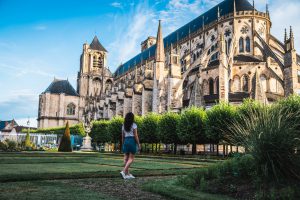
UNESCO recognizes Bourges Cathedral as a masterpiece of Gothic architecture, and the reasons become clear the moment you step before its five…
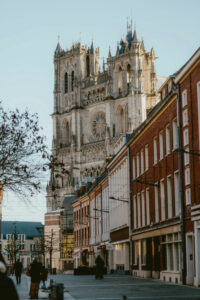
Step off the bustling streets and into a world where monumental medieval grandeur meets gentle waterways and lush greenery. Amiens offers a…
Would you like to plan a similar experience? Request your personalized itinerary.