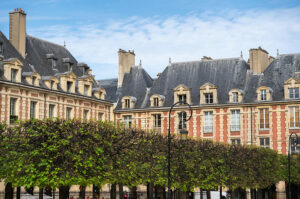
Le Marais, Paris — Guided Walk through Hôtels Particuliers, Memory, and Living Cultures
Paris keeps its past in plain sight, and nowhere does the city read more clearly than in the Marais. Here, an early‑17th‑century…
Fill up on discoveries
We organize your transport by coach, train or plane
Discover the most beautiful historical monuments of our heritage
Go alone or in a group to discover these places
You won't miss a single detail - they know their subject inside out.
Most visitors to Paris know Notre-Dame, the Eiffel Tower and Versailles.
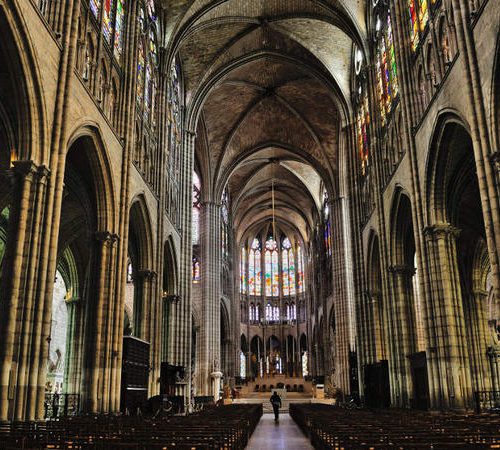
Far fewer discover one of France’s most extraordinary historic landmarks: the Basilica of Saint-Denis.
Located just north of Paris, this remarkable monument is often described as the French equivalent of Westminster Abbey. For more than a thousand years, it has been associated with French royalty and remains the burial place of most of the kings and queens who shaped the history of France.
Combining royal history, stunning Gothic architecture and fascinating stories from the French monarchy, the Basilica of Saint-Denis is one of the most rewarding cultural experiences near Paris.
For travelers interested in castles, kings, queens, the French Revolution or medieval architecture, it is an unforgettable destination.
The Basilica of Saint-Denis occupies a unique place in French history.
For centuries, it served as the royal necropolis of France, becoming the final resting place of monarchs, princes and queens from some of the country’s most influential dynasties.
More than 70 royal tombs can be found inside the basilica, making it one of the most important royal burial sites in Europe.
No other monument tells the story of the French monarchy so completely.
Visitors can follow nearly 1,500 years of French history through the lives of rulers whose decisions shaped the nation, influenced Europe and transformed the world.
One of the most compelling reasons to visit Saint-Denis is its extraordinary collection of royal tombs.
Among the famous figures buried here are:
Numerous kings, queens, princes and princesses of France
The funerary sculptures are masterpieces in their own right.
Some depict rulers in prayer, while others present highly realistic representations that reveal changing artistic styles across the centuries.
Walking through the royal necropolis feels like walking through the pages of a history book, where each tomb tells a story of power, ambition, triumph and tragedy.
For many international visitors, the most famous names associated with Saint-Denis are Louis XVI and Marie-Antoinette.
Following the French Revolution, their remains experienced a turbulent history before eventually being reinterred in the Basilica of Saint-Denis.
Today, visitors can pay tribute to one of history’s most famous royal couples while learning about the dramatic events that transformed France at the end of the eighteenth century.
For those fascinated by Versailles, Marie-Antoinette or the French Revolution, Saint-Denis provides an essential historical perspective that complements a visit to the Palace of Versailles.
Saint-Denis is not only important because of its royal connections.
It is also considered the birthplace of Gothic architecture.
In the twelfth century, Abbot Suger oversaw a revolutionary rebuilding project that transformed the abbey church and introduced architectural innovations that would influence cathedrals throughout Europe.
Features that became hallmarks of Gothic architecture first appeared here, including:
Without Saint-Denis, many of Europe’s most famous cathedrals—including Notre-Dame de Paris—might have looked very different.
For architecture enthusiasts, the basilica is one of the most significant buildings in European history.
One of the most surprising aspects of Saint-Denis is how many visitors overlook it.
While major Paris attractions often attract large crowds, the Basilica of Saint-Denis remains relatively undiscovered by international tourists.
This allows visitors to enjoy a more peaceful and immersive experience.
Instead of navigating crowded corridors, travelers can take time to admire the architecture, explore the royal tombs and connect with centuries of history in a calm and authentic setting.
Many visitors leave wondering why this extraordinary monument is not better known.
The Basilica of Saint-Denis is located just a short distance from central Paris and is easily accessible by public transportation.
Its proximity makes it an excellent addition to a Paris itinerary, particularly for travelers interested in:
The visit can easily be combined with other historical sites throughout the Paris region.
A visit to Saint-Denis offers several highlights:
Every section of the basilica reveals another chapter of French history.
Whether your interests lie in architecture, monarchy, religion or art, there is something fascinating to discover.
Many American travelers visit France to discover castles, royal palaces and the stories of French kings and queens.
The Basilica of Saint-Denis brings all of those themes together in a single location.
Unlike Versailles, which showcases royal life, Saint-Denis tells the story of royal legacy.
It offers a deeper understanding of France’s rulers, the French Revolution and the cultural foundations of the nation.
For visitors seeking experiences beyond the most famous tourist attractions, Saint-Denis often becomes one of the most memorable discoveries of their trip.
The Basilica of Saint-Denis is much more than a church.
It is the resting place of French royalty, the birthplace of Gothic architecture and one of the most important historical monuments in Europe.
For anyone interested in French kings and queens, medieval architecture, the French Revolution or hidden gems near Paris, a visit to Saint-Denis offers a unique and unforgettable experience.
Few places allow visitors to stand so close to the people who shaped the history of France.
And few monuments tell that story as beautifully as the Basilica of Saint-Denis.
The Basilica of Saint-Denis is famous for being the burial place of most of the kings and queens of France and for being considered the birthplace of Gothic architecture.
Absolutely. It is one of France's most important historical monuments and offers a unique combination of royal history, Gothic architecture and cultural heritage just outside Paris.
Yes. Visitors can explore the royal necropolis and see the tombs and funerary monuments of many French monarchs, including Louis XVI, Marie-Antoinette and François I.
Paris keeps its past in plain sight, and nowhere does the city read more clearly than in the Marais. Here, an early‑17th‑century…
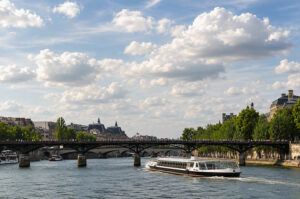
There is a reason the very heart of Paris is defined by its river. The historic banks of the Seine—bridges, quays and…
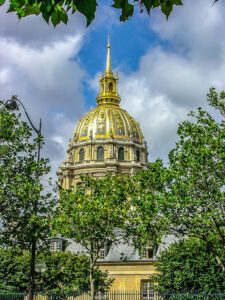
Founded by Louis XIV in 1670 as a home for wounded and aging soldiers, Les Invalides later became the resting place of…
Would you like to plan a similar experience? Request your personalized itinerary.